
Engineering Teardown: How to Manufacture a $59 Custom MagSafe Camera Grip (DFM, Materials & Tooling Cost Breakdown)
Snap-on mobile photography grips retail between $39 and $69 across DTC brands and Amazon US, yet their mechanical core relies almost entirely on precision plastic injection molding. For hardware startups and creator brands, this teardown breaks down the bill of materials (BOM), the critical DFM tolerances, and how to scale from 3D-printed prototypes to 1,000-unit bridge tooling without a six-figure mass-production mold investment.
Inside a MagSafe Camera Grip: 5-Part BOM Architecture
This looks like complex electronics, but it is mostly precision plastic structure plus simple off-the-shelf parts. That is exactly where an injection molding partner adds the most value.
Ergonomic Main Housing
Top and bottom shells set drop resistance and the DSLR-style fullness of the grip. Molded in high-rigidity PC+ABS or PC+10% GF.
Injection moldedTactile Finger Grip Pad
Budget brands get grip from mold texture (VDI 3400 / leather-grain etching) in a single material. Flagship brands use TPU two-shot overmolding for a soft, skin-friendly feel.
Texture or overmoldMagSafe N52 Magnet Ring Array
A ring of 16–18 arc-shaped N52 neodymium magnets. Pull force depends on the tolerance of the plastic locating ribs that hold them.
Rib tolerance is critical1/4″-20 Brass Tripod Insert
A knurled brass nut for the standard tripod thread, added by insert molding or ultrasonic heat staking.
Insert molding / heat stakingOff-the-Shelf Bluetooth Shutter
A standard low-power BLE shutter board with a CR2032 holder (or a basic lithium cell). Buy a proven PCBA; about 90% of your R&D goes into button travel and snap-fit assembly.
Purchased part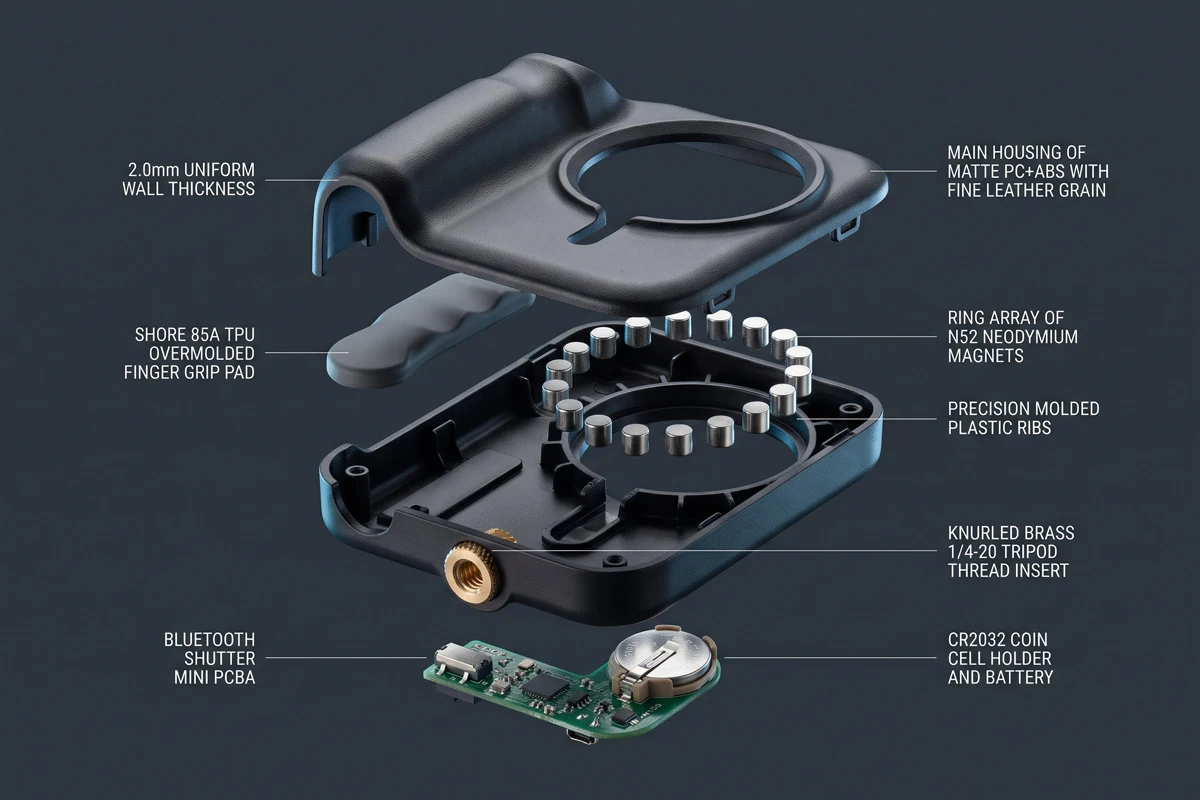
4 Critical DFM Challenges (And How We Solve Them in Tooling)
These are the four structural failures behind most negative reviews of comparable grips on Amazon. Each one is decided at the DFM stage, long before steel is cut. Our precision plastic injection molding services start with this review, including two-shot overmolding and tight-tolerance rib design.
1. Magnet array detachment and weak pull force
2. DSLR-grade ergonomics without sink marks
3. Securing the 1/4″-20 insert against torque stripping
4. A crisp, rattle-free shutter button
Startup Unit Economics: 3D Printing vs. Bridge Tooling vs. Mass Production
The numbers below use a $59 retail price. Shell BOM covers the molded housing only, not magnets, electronics, or packaging.
| Stage / process | Tooling investment | Shell BOM / unit | Best for | Gross margin at $59 |
|---|---|---|---|---|
| 3D printing (MJF / SLA) | $0 | $14.00 – $22.00 | 1 – 200 pcs | ~60% (rough surface, crowdfunding validation only) |
| P20 bridge tooling | $2,800 – $4,500 | $1.80 – $2.90 | 1,000 – 5,000 pcs | >88% (tooling recovered by about 500 units) |
| S136 multi-cavity production mold | $8,500 – $15,000+ | $0.95 – $1.45 | 10,000+ pcs | >92% (established brands scaling up) |
Break-even point: at roughly 250–300 units, the extra per-piece cost of 3D printing already exceeds the total price of a P20 steel mold. Starting at a 1,000-piece MOQ on rapid bridge tooling for hardware startups drops the shell cost to about $2 per unit and gives you production-grade laser texture and two-shot overmold quality from the first batch.
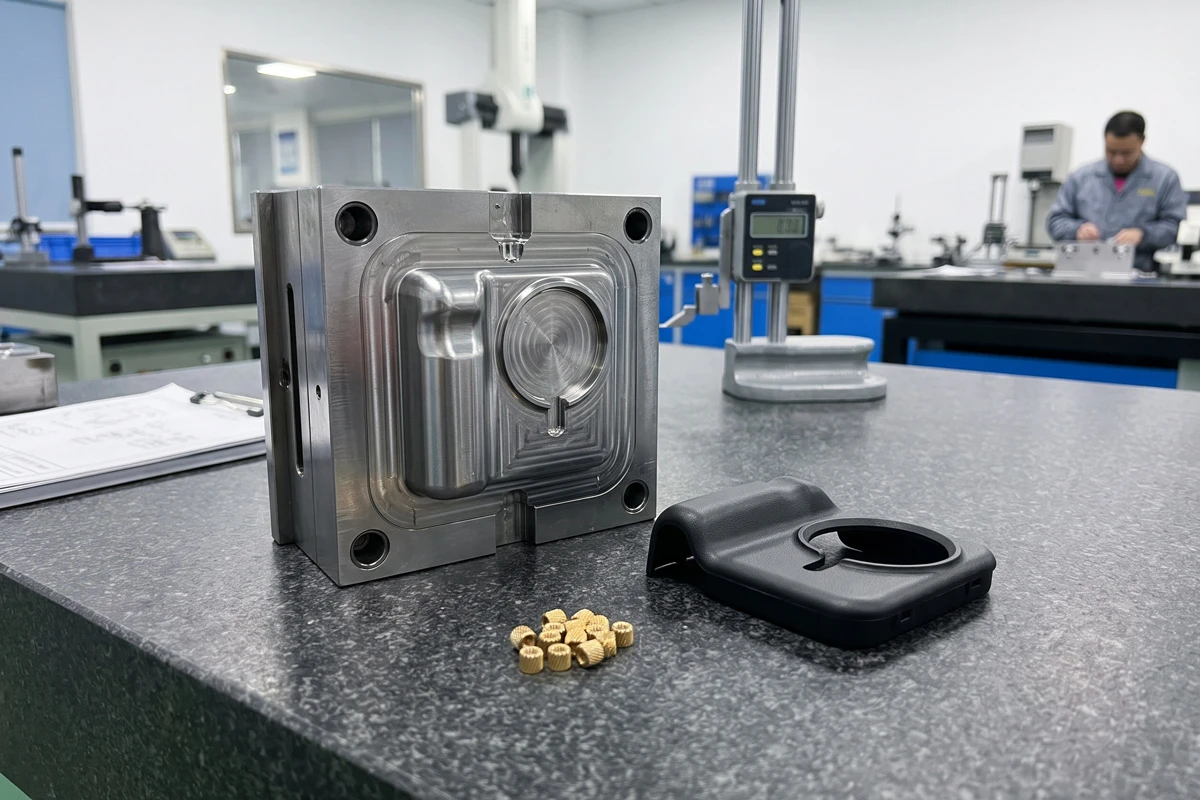
Ready to Scale Your Mobile Creator Accessory from CAD to Production?
Whether you are moving a 3D-printed prototype to production after a successful Kickstarter, or developing a new MagSafe hardware line, our engineers provide 1,000-unit low-MOQ bridge tooling and full DFM structural optimization.
Material Selection Matrix for Different Brand Tiers
Pick the tier that matches your price point, then see the tooling and machine capability behind it.
Budget single-material launch
- Materials: Makrolon® PC+ABS alloy with mold-tech leather texture etching.
- One main-shell mold only, with no overmold tool. Tooling cost is about 35% lower.
- Etched texture gives a leather-like anti-slip look, well suited to a first Kickstarter batch.
Flagship Pro Creator Edition
- Materials: PC+10% GF glass-filled core plus Shore 85A TPU overmold, resistant to yellowing and sweat.
- The rigid skeleton resists drops and warping.
- The damped overmold grip feels like a mirrorless camera handle and supports a $65+ brand premium.
| Parameter | Capability |
|---|---|
| Machines | 50T – 800T injection presses |
| Mold steel | P20 (bridge), NAK80 / S136 (production), 300k–500k shot life |
| Tolerance | ±0.01mm standard; ±0.005mm on special processes such as LSR |
| Materials | PC, PC+ABS, PC+GF, TPU, LSR, POM, PPS and other engineering plastics |
| Processes | Two-shot and over-molding, insert molding, ultrasonic heat staking, laser texture |
High-Value Niche Applications
The same tooling, material, and assembly skills behind a camera grip carry across other accessories with a $30+ retail price.
VR / AR structural parts
Lightweight frames and mounts with tight fit and stable dimensions.
Medical-grade accessories
Cleanroom-molded housings and seals built under ISO 13485 controls.
Wearable skin-contact parts
TPU and LSR overmolds that stay soft and resist sweat and yellowing.
Industrial seals and cases
Sealed protective housings where dimension and fit are non-negotiable.
Quality Control & Equipment
Every shipment is measured against your drawing, and every defect gets a documented root cause.
Inspection equipment
- CMM (three-coordinate measuring machine)
- 2.5D optical projector
- 100-grid cross-hatch adhesion test (overmold bond)
- RCA abrasion test for texture and coatings
Environment & closed-loop response
- ISO Class 8 cleanroom molding
- Root-cause tracing for every quality exception
- 8D report and negotiated resolution
Commercial Policy & Asset Safety
Terms built to lower the risk of a first production run.
NDA first
We sign an NDA before you share any CAD files.
100% mold ownership
The mold belongs to you once it is fully paid.
1,000-piece pilot MOQ
Validate demand and fit without a large inventory bet.
EXW or DDP
Pay by 100% prepayment or 50/50 deposit. Net 30 is available for qualified customers.
Frequently Asked Questions
Quick answers for engineers and sourcing managers.
- 3D printing: $14–$22 per shell, no tooling
- P20 bridge tooling: $2,800–$4,500
- S136 multi-cavity mold: $8,500–$15,000+
- Single-material PC+ABS: about 35% lower tooling cost, leather-grain look
- PC+GF core with Shore 85A TPU: softer damped grip, supports $65+ pricing
Still have a question about your project?
Send your .STEP or .X_T file and get a free DFM review and tooling quote within 24 hours.