
A trading card accessory brand came to YG Tech mid-way through a product line expansion, looking for a new way to protect PSA-graded slabs. The timing wasn’t random — trading card sales at major U.S. retailers have been climbing sharply, with Walmart Marketplace reporting card sales up roughly 200% year over year and Target tracking toward $1 billion in card sales in 2025. Brands that only sold sleeves and deck boxes are now racing to cover the graded-slab side of the hobby too.
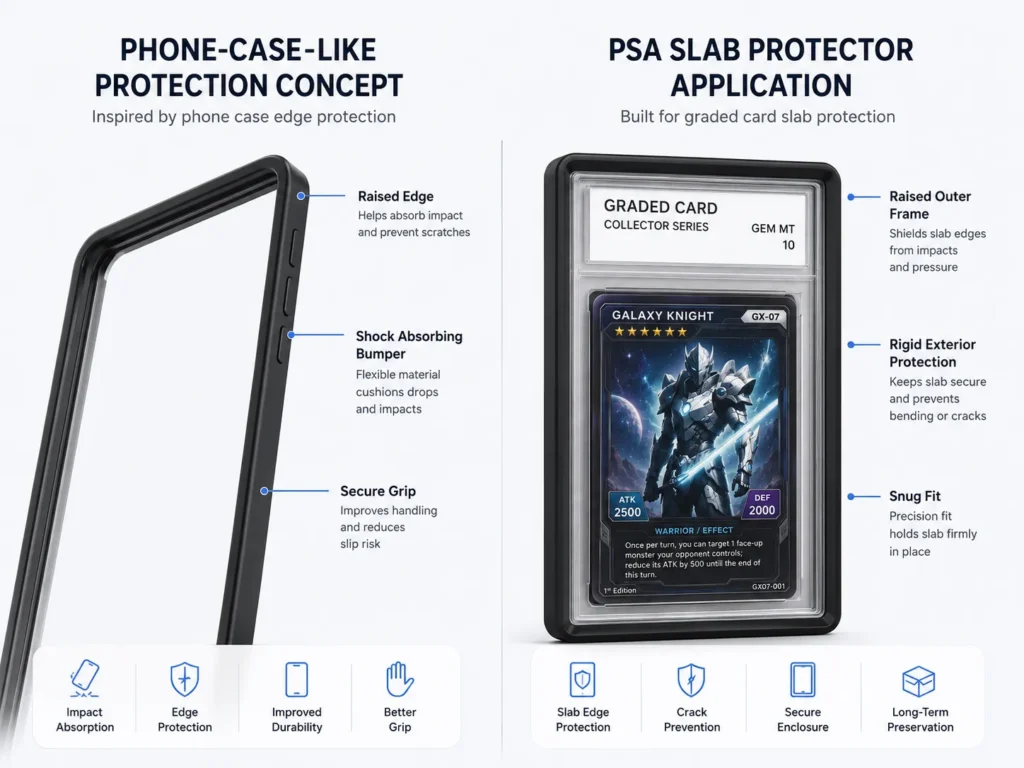
The client’s idea was simple to describe and harder to execute: build something that protects a slab the way a phone case protects a phone, sized for a graded card holder instead of a handset. It needed to hold the slab securely, support several color options for different retail SKUs, and look and feel like a premium accessory rather than a basic sleeve.
YG Tech took on the project from a manufacturing standpoint rather than a pure design brief — reviewing structure, fit, material selection, color-gradient feasibility, mold development, injection molding, and packaging support as one connected process instead of separate handoffs.
Project Snapshot
| Item | Details |
|---|---|
| Client | Trading card accessory brand |
| Industry | Collectibles and trading card accessories |
| Product | PSA slab protector accessory |
| Application | Protective outer case for PSA graded card slabs |
| Material Direction | Clear PC sheet + TPU frame |
| Main Requirement | A phone-case-like protective accessory designed to fit PSA slabs |
| Key Focus | Accurate fit, edge protection, clear display, color gradients, and retail-ready structure |
| Services Provided | Product review, DFM support, material selection, prototyping, mold development, injection molding, color testing, quality inspection, and packaging support |
The Client’s Request
The client was already selling plastic holders and wanted to extend the line with a protective case built specifically for PSA slabs — not a generic storage box. A phone case was the closest reference point everyone on the call understood immediately, so that became the shorthand for the brief: keep the protective logic, but rebuild the shape, size, and handling feel around a graded card holder instead of a smartphone.
Three things mattered beyond fit. The case had to protect the slab’s edges without ever covering the card face or the grading label — the whole point of a graded slab is that the label and card stay visible and verifiable. It needed to read as a retail product, not a utility sleeve, since it would sit on shelves next to other display-ready collectibles. And the client wanted to know, concretely, what YG Tech could do with color gradients, because card grading volume has kept climbing — PSA and its peers graded over 26 million cards in 2025 alone — and a wider color range meant more retail SKUs built from one core structure to serve that growing base of newly slabbed cards.
Project Goals
The first goal was to fit standard PSA slabs with stable sizing. The protector needed to hold the slab securely, but it could not be too tight or difficult to remove.
The second goal was edge protection. The product had to work like a phone case, protecting the outside frame while keeping the card face and grading label clear.
The third goal was color flexibility. The client wanted to explore multiple color gradients, so the TPU frame needed to support different visual options for future product lines.
The final goal was production readiness. The structure had to work for sampling, mold development, injection molding, quality checks, and packaging, not only as a design concept.
Key Manufacturing Challenges
The core challenge was translating a phone-case concept into a genuinely different product shape. The protective logic carries over — absorb impact, shield the corners, keep a firm grip — but a phone case wraps around a device with buttons, cameras, and curved edges, while a slab protector has to fit a flat, rigid holder with fixed corners and a clear viewing window front and center. There was no curved geometry to hide behind; every edge and corner of the frame had to be dimensioned deliberately.
Fit tolerance turned out to be the more demanding of the two problems. Graded slabs hold fairly consistent external dimensions, but a frame cut too loose lets the slab shift and rattle inside the case, while a frame cut too tight makes insertion and removal a fight — exactly the kind of one-star review a phone case would also earn if it fit wrong on either end of the tolerance stack. Getting that dialed in meant treating the frame opening as a precision fit problem, not a generic pocket.
The material structure raised a second set of questions. The clear PC window had to stay optically clean so the card and grading label stayed fully legible, while the TPU frame around it needed to deliver grip, flex, and corner protection without going soft or bulky. Layered on top of that, the client’s request for multiple color gradients meant the production process also had to account for color testing, gradient transition quality, and batch-to-batch consistency before anything moved toward bulk manufacturing.
YG Tech’s Engineering Approach
YG Tech started with a structure review and DFM evaluation. The team checked the target PSA slab size, frame coverage, opening direction, wall thickness, and mold feasibility.
The product needed to protect the edge without covering the card face. This meant the frame shape had to be controlled around the slab corners and side edges.
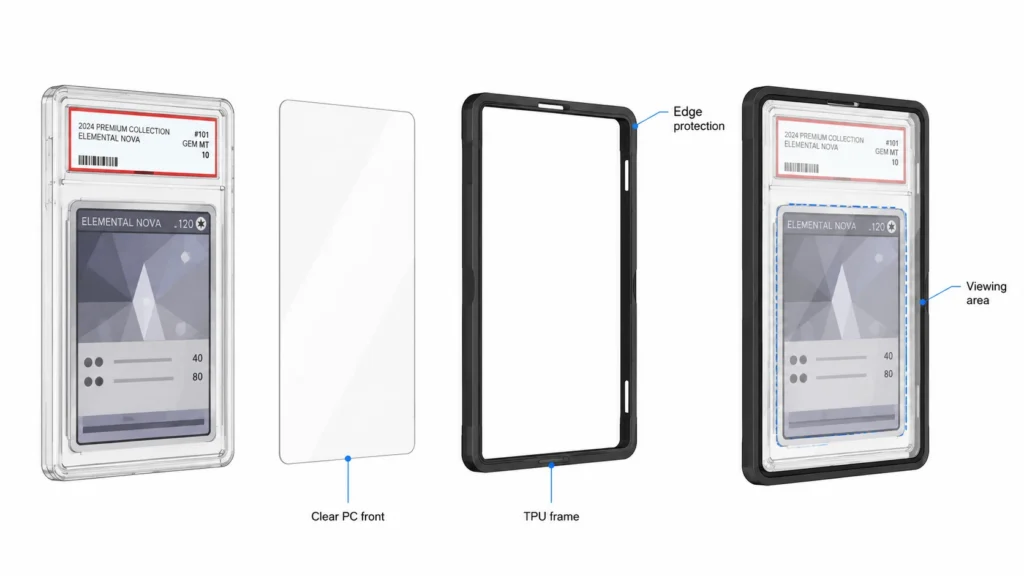
For material selection, the proposed structure used a clear PC sheet and a TPU frame. The PC sheet provided a stable transparent viewing area, while the TPU frame added flexibility, grip, and corner protection.
The color gradient requirement was reviewed during the early development stage. YG Tech evaluated how the TPU frame could support different color effects through material testing, color samples, and process control.
Prototype sampling was used to check the actual product feel. The team reviewed fit, insertion, removal, edge coverage, transparency, color appearance, and handling before moving forward.
Mold Development and Injection Molding
Once the structure and sample direction were locked in, the project moved into mold development. The tooling needed to hold stable frame dimensions, produce clean edges shot after shot, and support repeatable production runs rather than one-off samples. For the TPU frame itself, injection molding formed the protective outer structure, with process control focused on flexibility, shape stability, corner coverage, and — critically for a multi-SKU product — color consistency from batch to batch.
→
Prototype Sampling
→
Mold Development
→
Injection Molding
→
Quality Inspection
→
Packaging
The clear PC window had to match the TPU frame precisely at every step, keeping the front face flat and clean without disturbing card visibility or the overall handling experience. During trial runs, the team’s quality inspection checks covered slab fit, insertion feel, edge wrapping, surface marks, color appearance, and packaging compatibility — the same categories a buyer would judge the product on, checked before bulk production rather than after. For a two-material product combining rigid PC and flexible TPU, even small structural changes can shift final fit and appearance, which made this trial-run stage worth the extra time it cost upfront.
Final Product Features
The final product direction was a PSA slab protector with a clear PC front and a flexible TPU frame. The structure kept the card face and grading label visible while adding protection around the slab edge.
The TPU frame gave the product a phone-case-like handling feel. It improved grip, helped protect the corners, and made the accessory feel more structured than a soft sleeve.
The product also supported multiple color gradient options. This gave the client more room to build different retail SKUs from the same base structure.
The finished design was suitable for retail packaging and distributor channels. It combined clear display, edge protection, color customization, and repeatable manufacturing in one protective accessory.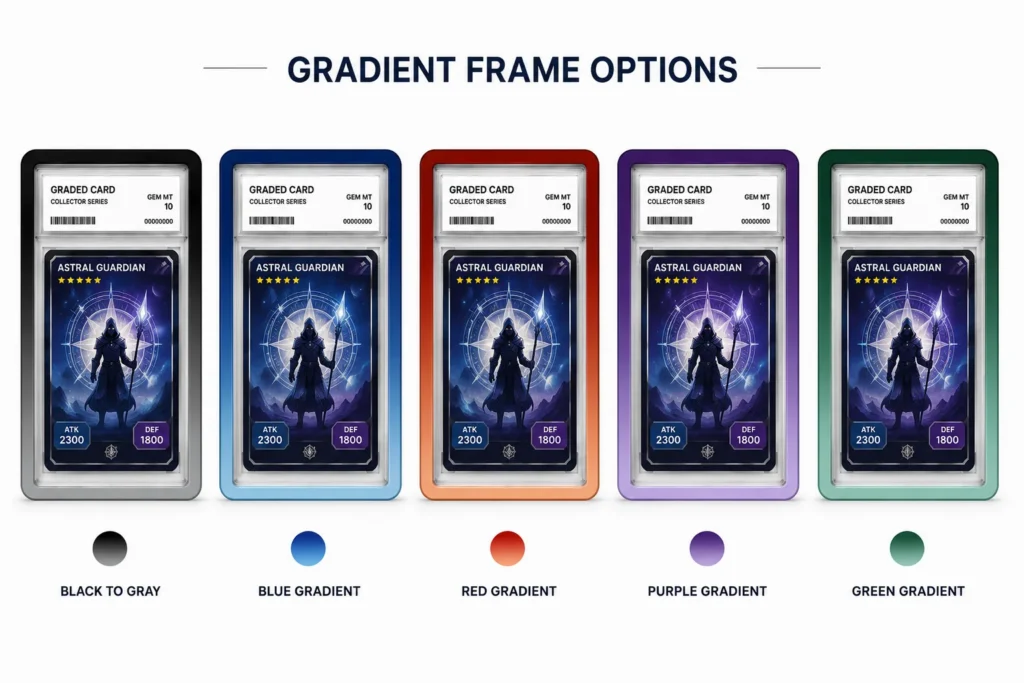
The Results
The project moved an early “similar to a phone case” concept into a fully manufacturable PSA slab protector structure, adapted at every step to the actual shape and handling needs of a graded card slab rather than borrowed wholesale from a smartphone accessory. The PC-and-TPU construction gave the product a clean functional split: the PC area carried card display and legibility, while the TPU frame carried grip, edge protection, and color flexibility — two jobs, two materials, one assembled part.
The gradient color options did more than add shelf appeal — they let the client plan a genuinely wider product line from a single tooling investment, launching several color styles across retail channels instead of committing to one standard version. And by running structure review, prototype sampling, mold development, and injection molding checks as one continuous process rather than sequential handoffs, YG Tech helped the client de-risk the path to bulk production well before the first commercial order shipped.
Developing a protective holder, slab protector, device cover, or another custom plastic accessory? Send over your product concept, target material, color requirements, 3D files, drawings, or physical samples — our engineering team can support DFM review, prototype sampling, mold development, injection molding, quality inspection, and packaging, from an early-stage idea through a standard 1,000-piece first production run.
Send Us Your Concept →