
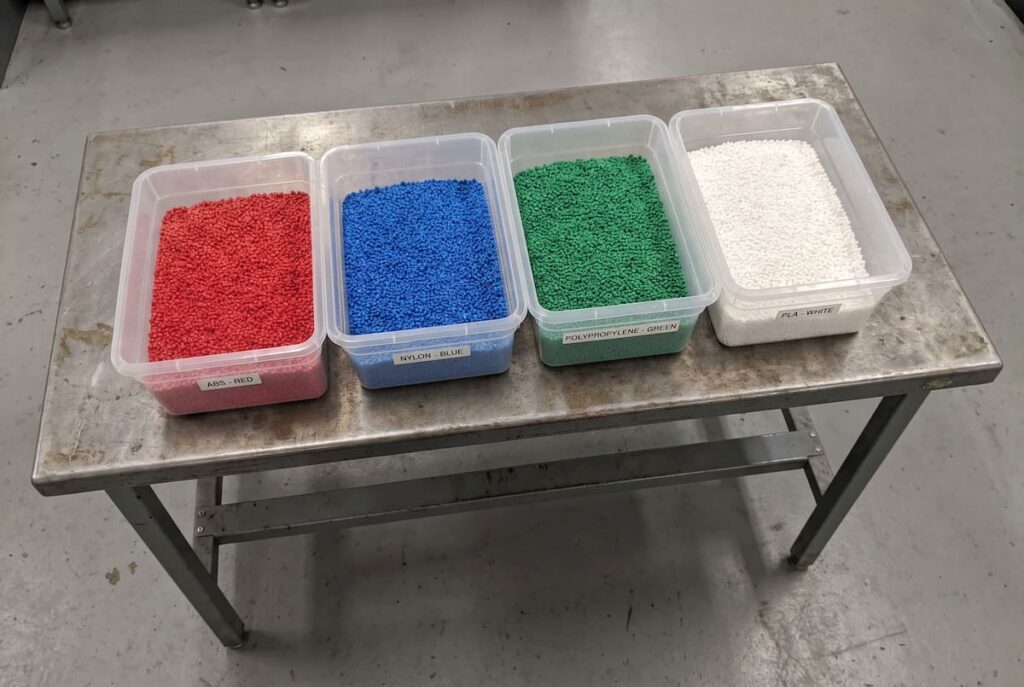
Most material selection mistakes don’t show up on a datasheet — they show up three weeks later, when the mold steel has already been cut to a shrinkage rate that no longer matches the resin the buyer actually wants to run. After close to three decades cutting steel for consumer and industrial accessories, the pattern in our project files is consistent: the resin decision gets made too late, or made on strength numbers alone, while shrinkage behavior, fiber content, and certification scope get treated as details to sort out after tooling is quoted. This guide walks through the three decisions that actually determine whether a mold performs — material family, reinforcement level, and compliance — before you compare resin grades line by line.
Start With the Application’s Failure Mode, Not the Resin Catalog
Buyers usually start a material search by browsing resin comparison charts. That’s backwards. A more useful starting point is asking how the part is most likely to fail in the field — under load, under heat, under UV, or under a customs inspector’s compliance checklist — and only then narrowing to resin families that survive that specific failure mode.
For the accessory-class parts we typically quote — device cases, structural brackets, protective enclosures for $30+ retail goods — six questions cover most of the decision:
| Selection Criterion | Key Question to Ask First | Resin Families Typically Considered |
|---|---|---|
| Mechanical load & impact | Will it be dropped, flexed repeatedly, or carry a working load? | PC, PC/ABS, Nylon, POM |
| Operating temperature | What’s the highest sustained temperature, including shipping and storage? | PBT, high-heat Nylon grades, PPS |
| Chemical / UV exposure | Will it contact solvents, sunscreen, salt water, or direct sunlight? | ASA, PC/ASA, chemical-grade PP |
| Appearance & finish | Does it need to stay optically clear or hold a consistent color? | PC, PMMA, ABS |
| Regulatory scope | Does the market require FDA, UL94, ISO 10993, or RoHS/GRS coverage? | Certified engineering-grade resins only |
| Landed cost at volume | What’s the target per-part resin cost at your actual production quantity? | Commodity (PP, ABS) vs. engineering resins |
Rank these before you open a single material datasheet. A part that needs to survive outdoor UV exposure and a $12 landed-cost ceiling is a different conversation than one that needs FDA contact approval and tight snap-fit tolerances — even if both are, on paper, “plastic phone accessories.”
Why Amorphous and Crystalline Resins Shrink Differently — And Why That Decision Can’t Wait Until the Steel Is Cut
This is the single most expensive mistake we see, and it’s a physics problem, not a preference problem. Amorphous resins like ABS and PC cool with their molecular chains randomly tangled, so they contract in a fairly uniform, predictable way — typically 0.4% to 0.7%. Semi-crystalline resins like PP and Nylon form tightly packed crystalline regions as they cool, which pull the material into a much larger, direction-dependent contraction — often 1.5% to 2.5%, and higher along the flow direction than across it.
Approximate ranges for unpigmented, standard-flow grades. Actual values shift with wall thickness, mold temperature, and packing pressure.
The reason this can’t be a late decision is mechanical, not theoretical. A mold cavity is machined to a steel dimension that already accounts for a specific resin’s shrink rate — the cavity is deliberately built larger than the finished part by that percentage. Swap a resin family mid-project — ABS for PP, for example — and the tool is now cutting parts roughly 1% to 2% off in every dimension, which on a snap-fit or a sealed enclosure is the difference between a working part and scrap.
The practical fix is sequencing, not caution: lock the resin family before the mold steel is quoted, not after. If two resins are genuinely competing on cost or performance, that comparison belongs in the DFM stage, evaluated against tolerance and fit requirements — not resolved by guessing and correcting the steel later.
Adding Glass Fiber to Boost Strength: What You Gain, What You Risk in Tooling and Finish
Glass fiber reinforcement is often the right call for structural brackets, connector housings, and load-bearing accessory parts — but it’s rarely a free upgrade. It changes four things at once: mechanical performance, surface appearance, shrinkage behavior, and the steel spec the mold has to be cut from.
What Fiber Content Gains You
- Tensile strength often doubles or more at 30% GF loading versus unfilled resin
- Higher flexural modulus — less flex under sustained load
- Reduced creep, useful for parts under continuous clamping force
- Lower overall shrinkage magnitude, since fibers restrict free chain contraction
What It Costs You
- Anisotropic shrinkage — flow-direction and cross-flow dimensions diverge, raising warpage risk on flat or long parts
- Visible fiber “bloom” or surface swirl, especially under gloss or paint finishes
- Abrasive wear on cavity surfaces, gates, and runners — softer mold steel degrades within a few production runs
- Increased brittleness; impact resistance can drop even as tensile strength rises
The tooling consequence is the one buyers most often miss at quoting stage. Unfilled or lightly filled resins run comfortably on general-purpose mold steel, but once glass content climbs past roughly 15%–20%, that abrasion accelerates cavity wear fast enough to shorten mold life and degrade cosmetic surfaces run after run. Mold steel suppliers now offer specialty hardened grades reaching as high as 58 HRC specifically to hold up against the abrasive wear that glass-reinforced resins cause in high-volume production tooling (Source: Moldmaking Technology). That’s a different — and higher-cost — steel spec than a standard P20 tool built for unfilled ABS, and it’s a conversation worth having with your toolmaker before the fiber percentage is finalized, not after the first short-shot shows up.
We’ve also seen this show up as a surface defect issue more than a strength issue: a part specced for 30% GF to hit a stiffness target, but the visible face was never flagged for fiber bloom, and the client ends up choosing between a secondary paint step or a lower fiber loading late in the program.
Keeping FDA, UL94 V-0, or ISO 10993 Compliance Intact After Colorants and UV Stabilizers
A resin’s certification covers the exact formulation and wall thickness that was tested — not the base polymer in general. That distinction is where a lot of compliance risk quietly enters a project.
UL certification is tied to the specific formulation and thickness that was tested; swapping in a new colorant, UV stabilizer, or additive package — even within the same base resin — can invalidate the rating until it’s re-verified against the new formulation (Source: Protolabs).
The same logic applies to FDA food-contact status and ISO 10993 biocompatibility: those approvals are granted to a tested formulation, not a resin family. A pure PC grade might carry both a UL94 V-0 rating and FDA-compliant status on its technical data sheet, but once a factory adds a custom color masterbatch, an antistatic package, or a UV stabilizer to hit your spec, that as-molded part is technically a new formulation until it’s been reverified.
For buyers in regulated categories, three steps close that gap before it becomes a shipment held at customs or a failed retail compliance audit:
- Request the Certificate of Analysis on the as-molded finished part, not just the base resin’s technical data sheet
- Confirm the masterbatch carrier resin and dosage are compatible with the certification your part needs, in writing, before production tooling starts
- Re-verify compliance any time the color, UV package, or supplier of any additive changes — even mid-program
This is also where traceable quality documentation earns its keep: a factory that can produce batch-level COAs tied to the specific resin lot and additive dosage used on your parts gives you something to hand a compliance auditor, rather than a promise.
A Quick Reference: Common Resins at a Glance
For a first-pass shortlist, this is roughly how the resins we run most often for accessory-class parts compare on the dimensions that matter for mold design and cost:
| Resin | Type | Typical Shrinkage | Relative Cost | Where It Fits |
|---|---|---|---|---|
| ABS | Amorphous | 0.4%–0.7% | $ | General enclosures, cosmetic parts |
| Polycarbonate (PC) | Amorphous | 0.5%–0.7% | $$$ | Impact-resistant, clear or tinted housings |
| Polypropylene (PP) | Semi-crystalline | 1.5%–2.5% | $ | Living hinges, chemical-resistant parts |
| Nylon PA6 (unfilled) | Semi-crystalline | 1.5%–2.5%, moisture-sensitive | $$ | Wear parts, gears, snap-fits |
| PA66-GF30 | Semi-crystalline, fiber-filled | 0.3%–0.9%, anisotropic | $$$ | Structural brackets, high-stress accessories |
| POM (Acetal) | Semi-crystalline | 1.8%–2.5% | $$ | Precision gears, low-friction mechanisms |
| ASA | Amorphous | 0.4%–0.7% | $$ | Outdoor housings, UV-exposed parts |
Treat this as a shortlist generator, not a final answer — the right grade within any of these families still depends on flow length, wall thickness, and the specific certification your market requires.
Three Selection Mistakes We See Most Often From First-Time Buyers
Choosing the material after the tooling quote, not before. A buyer locks a mold quote against a placeholder resin to move fast, then finalizes the actual material later. If that final resin has a different shrinkage profile — which it usually does — the cavity dimensions no longer hold, forcing a steel rework that costs more in time and money than getting the material decision right up front would have.
Treating regrind ratio as a pure cost lever. Adding 20%+ regrind to cut resin cost, without retesting impact or drop performance at that ratio, is a common shortcut on structural accessory parts. Each pass through the barrel shortens the polymer chains under heat and shear, so mechanical properties degrade cumulatively — not linearly — and the failure often doesn’t show up until a customer drop-tests the finished product.
Assuming a base resin’s certificate transfers to the finished part. A UL94 V-0 or FDA-listed resin grade goes into production with a custom color or UV additive that was never re-tested against that certification. The gap usually surfaces at the worst possible time — a customs hold, or a retail compliance audit — rather than during development, when it would have been a quick fix.
Frequently Asked Questions
What is the most common material used in plastic injection molding?
ABS and polypropylene (PP) are the two most widely used resins in injection molding. ABS is favored for cosmetic enclosures and consumer product housings, offering a workable balance of stiffness, impact strength, and surface finish at moderate cost. PP leads by overall volume, used heavily in living-hinge parts, packaging, and chemical-resistant containers due to its low cost and flexibility. For structural or higher-performance accessories, nylon and polycarbonate are the typical next step up.
How do you choose the right plastic resin for an injection molded part?
Start from the part’s likely failure mode, not a resin comparison chart. Work through these in order:
- Mechanical load — what forces, drops, or flex cycles will it see?
- Thermal exposure — what’s the highest sustained temperature, including shipping and storage?
- Chemical/UV exposure — will it contact solvents, sunscreen, salt water, or direct sunlight?
- Appearance — does it need to stay clear, hold color, or take a texture or paint finish?
- Regulatory scope — does it need FDA, UL94, ISO 10993, or RoHS/GRS compliance?
- Cost at volume — what’s the target landed cost per part at your actual production quantity?
Only after ranking these should specific resin grades be compared against each other.
What is the difference between commodity plastics and engineering plastics?
Commodity plastics — PP, PE, PS, and standard ABS — typically cost $1.50–3 per kilogram and deliver baseline mechanical properties suited to general enclosures and low-stress parts. Engineering plastics — polycarbonate, nylon, POM, PBT — run roughly $4–15+ per kilogram, formulated for higher strength, heat resistance, or dimensional precision that commodity resins can’t hold consistently, shot to shot. The dividing line isn’t a fixed spec; it’s whether the part genuinely needs sustained load capacity, elevated temperature performance, or tight tolerance that a commodity resin can’t guarantee.
Which injection molding plastic is best for outdoor UV resistance and weathering?
ASA (Acrylonitrile Styrene Acrylate) is generally the first choice for outdoor, UV-exposed parts, because unlike standard ABS it resists yellowing, chalking, and embrittlement under prolonged sunlight. PC/ASA blends add impact resistance where the part also needs to survive drops. Where polycarbonate is required for its clarity or strength, a UV stabilizer package needs to be compounded into the resin itself — not applied as a surface coating — and validated with actual weathering data at the wall thickness used, rather than a generic datasheet figure.
Can you mix recycled regrind resin with virgin plastic in injection molding?
Yes — most commodity and many engineering resins tolerate 10%–20% regrind blended with virgin material without a meaningful property drop, provided the regrind comes from clean, single-resin runner and sprue scrap. The caution is that each pass through the barrel shortens polymer chain length under heat and shear, so impact strength and elongation degrade cumulatively. Test drop or flex performance at the actual regrind ratio planned for production, rather than assuming datasheet values still apply. Structural, medical, or safety-critical parts should default to a lower regrind ceiling, or virgin-only where the spec allows no exceptions.
Why is polycarbonate (PC) so susceptible to stress cracking during injection molding?
PC’s high melt viscosity makes it difficult to fully relieve internal stress as the part cools, so parts leave the mold already carrying residual stress that a lower-viscosity resin wouldn’t retain. That stress concentrates at sharp internal corners, and later contact with certain solvents, oils, or alcohol-based cleaners can trigger environmental stress cracking — meaning a part can look flawless off the tool and fail weeks later in the field. Mitigation includes generous internal radii (at least 0.5× wall thickness), proper resin drying before molding, controlled mold and melt temperatures with adequate packing pressure, and, for high-stress geometries, an annealing step after molding.
Still deciding between two resins?
Send us your CAD and target wall thickness — we’ll run a free DFM review and flag any shrinkage, draft, or tolerance conflicts before steel gets cut.
Get a Free DFM Review →Already know your material, need a mold quote?
Our engineering team can walk through fiber content, steel spec, and tolerance stack-up directly with your project engineer.
Talk to Our Engineering Team →