
“Do we need a hot runner?” is a question that comes up on almost every multi-cavity quote, and the honest answer is usually “depends on your volume and your resin cost” — not a blanket yes or no. Hot runners aren’t an upgrade every program needs; they’re a specific tool for solving a specific cost problem. Here’s how to tell if that problem is actually yours.
What a Hot Runner System Actually Does
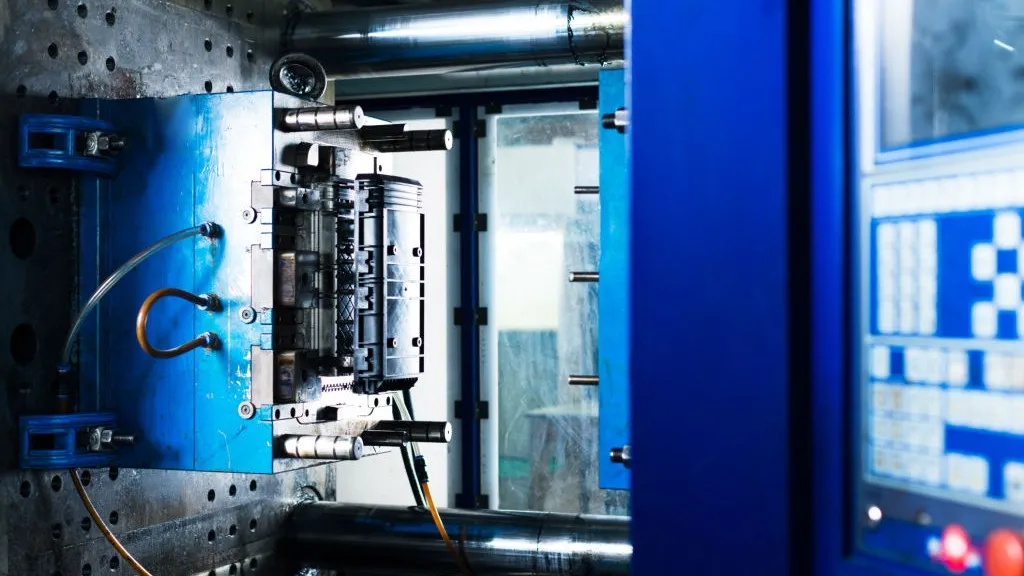
A cold runner mold feeds molten plastic from the machine nozzle to the cavities through channels that solidify along with the part every cycle — that solidified runner then gets ejected, trimmed, and either scrapped or reground. A hot runner replaces those channels with a heated manifold and heated nozzles that keep the resin molten all the way to the gate, so nothing but the part itself ever solidifies and ejects.
The direct payoff is straightforward: zero runner scrap, since there’s no runner to eject, and typically a faster cycle, since the part isn’t waiting on a runner to cool alongside it. The system itself adds real complexity, though — a heated manifold, individually controlled nozzle zones, and a dedicated temperature controller that has to hold every zone within a tight window, because a zone that runs too cold risks a frozen gate and one that runs too hot risks degrading heat-sensitive resin sitting in the melt path. That controller and manifold are also why hot runner tooling costs meaningfully more upfront and needs its own maintenance plan — which is the real tradeoff buyers are weighing, not “hot vs. cold” in the abstract.
Where the Investment Pays Back: Volume, Resin Cost, and Cosmetic Requirements
Three variables decide whether a hot runner earns its keep, and they compound each other rather than acting independently.
Volume is the obvious one — eliminating runner scrap only saves real money across enough shots to amortize the added tooling cost, so low-volume or short-lived programs rarely justify it. Resin cost matters just as much: a runner that wastes 20-30% of every shot is a rounding error on cheap commodity PP, but a meaningful cost on an expensive engineering resin, and it becomes a serious line item on specialty compounds. And cosmetic or functional requirements can justify a hot runner even at moderate volume — direct gating removes the need to trim and finish a gate vestige, and for parts where every visible surface matters, that alone can be worth the tooling premium, aside from the cost math entirely.
Where this plays out most clearly is in applications where hot runner technology has directly enabled a material switch that wouldn’t otherwise pencil out — reducing scrap and improving part consistency to the point that manufacturers have shifted entire product categories, including some medical packaging, from glass to plastic specifically because the hot runner made the economics and quality work (Source: Mold-Masters, via etmm-online, “Hot Runner Solutions for Enhanced Performance, Uptime and ROI,” September 2025). That’s the kind of case where the tooling premium isn’t really competing against a cold runner at all — it’s competing against a completely different, more expensive process.
For a typical accessory-class program, the practical question is less “hot or cold” and more “what does my full landed cost look like either way, including tooling amortization”.
Valve Gate vs. Hot Tip — and the Maintenance Tradeoff That Comes With Either
Once a hot runner makes sense, the next decision is gate type, and it’s not just a cost question.
Hot tip (thermal gate) systems are the simpler, more economical default: the small gate freezes naturally as the part cools, with no moving parts inside the nozzle. They work well for non-cosmetic or moderately cosmetic parts, but they do leave a visible gate vestige, and if the gate is sized wrong for the resin, a weak thermal seal can cause stringing or drooling at ejection. Valve gate systems add a mechanical pin that physically closes the gate at the end of injection, which gives a nearly invisible gate mark and precise, independently timed control over when each cavity (or each gate on a large part) opens and closes — useful for cosmetic parts, and essential for sequential or cascade filling on large, thin-walled geometries where a single gate can’t fill the part evenly. That control costs more per drop and adds moving parts that need periodic service.
The maintenance dimension is the part buyers often underweight at quoting stage. A hot runner system is a live, heated assembly with wear parts and seals, and manufacturers commonly offer factory refurbishment programs specifically because a worn or leaking hot runner degrades part quality gradually rather than failing all at once — one major supplier’s refurbishment program is positioned to save as much as 40% versus buying a new system outright, which is a reasonable proxy for how much of a hot runner’s lifetime cost sits in upkeep rather than the initial build (Source: Husky, hot runner solutions documentation). Budgeting for that service cycle up front, rather than treating a hot runner as a one-time tooling line item, avoids an unpleasant surprise a few hundred thousand shots into a production run.
Frequently Asked Questions
What is the main advantage of a hot runner over a cold runner?
Zero runner waste and, in most cases, a faster cycle. Because the resin stays molten all the way to the gate, nothing solidifies and ejects except the part itself, which eliminates both material scrap and the trimming or regrinding work a cold runner requires.
Is a hot runner always worth the extra cost?
No — it pays back fastest at higher volumes, on more expensive resins, or where a clean, invisible gate is a real cosmetic requirement. At low volume on cheap commodity resin with no cosmetic constraint, a cold runner is often still the lower-cost, lower-risk choice.
What’s the difference between a valve gate and a hot tip gate?
A hot tip relies on the gate freezing naturally as the part cools, which is simpler and cheaper but leaves a visible gate mark. A valve gate uses a mechanical pin to physically close the gate, giving a near-invisible finish and precise control over fill timing — useful for cosmetic parts and essential for sequential filling on large parts, at a higher cost per drop.