
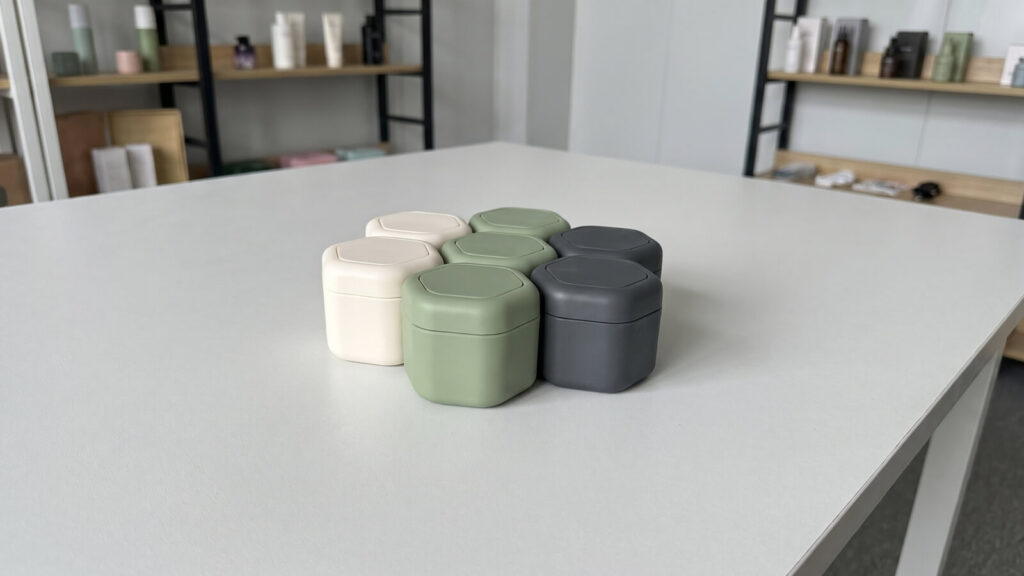
Browse a few DTC beauty and travel brands and you will find modular magnetic capsules sold as six-piece sets for $45 to $90. A plain refillable plastic jar sells for about $2 at a drugstore. These sets contain no battery, no PCBA and no firmware. The premium comes from three things a molder controls: a heavy, matte wall that feels like ceramic, magnets hidden inside the plastic, and a thread design that survives a flight without weeping. Below is how each one is built, followed by a realistic tooling budget for a first-time founder planning custom magnetic travel containers.
Getting a Ceramic-Like Heavy Feel with the Right Resin
Buyers judge a capsule by its weight before anything else. A thin-wall PP jar feels disposable; a capsule that sits in the palm like a river stone feels worth ten dollars. Two levers create that impression: resin density and wall design.
Resin choices
- Mineral- or talc-filled PP: density rises from about 0.90 to roughly 1.1–1.2 g/cm³, with a naturally chalky matte surface.
- PETG: about 1.27 g/cm³, available clear or tinted, so the formula color stays visible.
- Tritan-type copolyester: about 1.18 g/cm³, glassy and tough, but costlier and needs careful drying.
- PCR resin (ideally GRS-certified): the recycled-content story European buyers ask about. Expect slight color variation, so speckled or darker colorways work best.
Wall design and texture
The catch with heavy walls is sink. Thick sections cool more slowly than thin ones, which leads to sink marks, voids and warp, and Protolabs’ design guidance advises keeping walls uniform and coring out thick areas (Source: Protolabs injection molding guide). So we never mold a solid lump. We design a uniform 2.5–3.5 mm wall, place the gate at the heaviest point and allow enough pack and hold time. A fine matte grain etched into the cavity then softens reflections and hides faint flow lines.
The trade-off: in our experience a heavy-wall capsule cycles in roughly 35–50 seconds, against 15–20 for a thin jar, so cooling time drives cost.
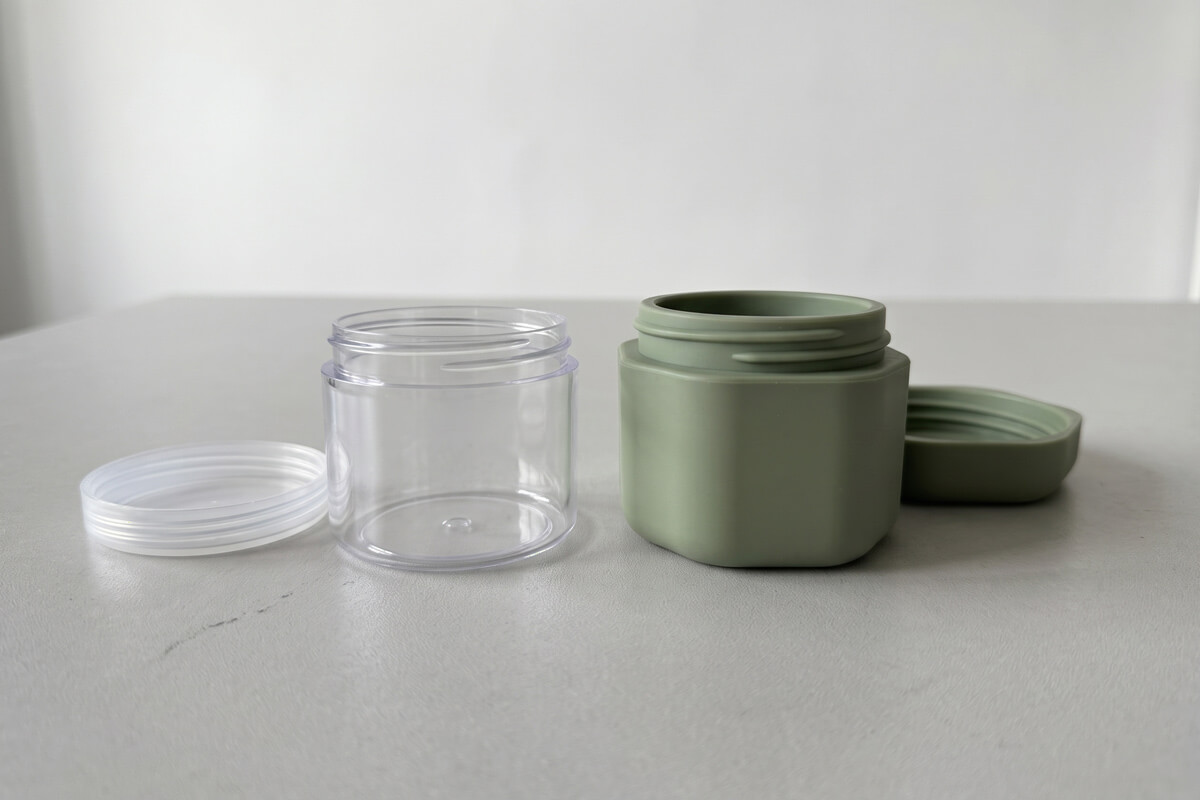
How the Magnets Stay Hidden and Aligned
Two questions come up in almost every inquiry: how do the magnets stay in, and why do six pods line up into a honeycomb?
Locking magnets into the plastic wall
| Method | How it works | Watch-out |
|---|---|---|
| Insert molding | The magnet sits in the open mold and plastic flows around it. No secondary assembly. | Melt heat and injection pressure can crack the magnet or weaken it. |
| Pocket + ultrasonic weld | The magnet drops into a molded pocket and a mating shell is welded over it. The magnet sees almost no heat. | Needs a well-designed weld joint and a thin, even cover wall. |
Timed threads for repeatable alignment
A honeycomb only works if every cap stops at the same angle. Three features make that happen:
- The thread start sits at the same angular position on every body and cap, so engagement always begins at the same point.
- A hard stop shoulder, not the gasket, decides the final position.
- The seal is sized to sit at 15–25% compression when the cap reaches that shoulder, so gasket squish never shifts the angle.
Even 5° of drift moves the rim by about 1.3 mm on a 30 mm capsule, enough to stop the magnets mating flat. Thread-start position is set in the mold design, which is why we check it during DFM, before any steel is cut.
Leak-Proof Engineering for Air Travel
Cabin pressure at cruise is typically equivalent to an altitude of about 6,000–8,000 ft, so air trapped in a partly filled capsule expands by roughly a quarter to a third. Keep each capsule at or under 100 ml (3.4 oz), the carry-on limit in the TSA’s 3-1-1 liquids rule (Source: TSA). Leak resistance comes down to four details:
- Thread fit and roundness: ovality ruins a seal faster than anything else. Our precision plastic injection molding typically holds sealing diameters to about ±0.05 mm.
- Sealing face: flat and free of sink or knit lines where the gasket lands.
- Gasket: food-grade silicone, or a TPE seal two-shot onto the cap.
- Material creep: PP threads relax over weeks, and slow weeping on a shelf is the classic symptom. PETG holds its fit better.
Ask any supplier to show test results: samples filled with dyed water, stored inverted for 24 hours, then run in a vacuum chamber to mimic cabin pressure.
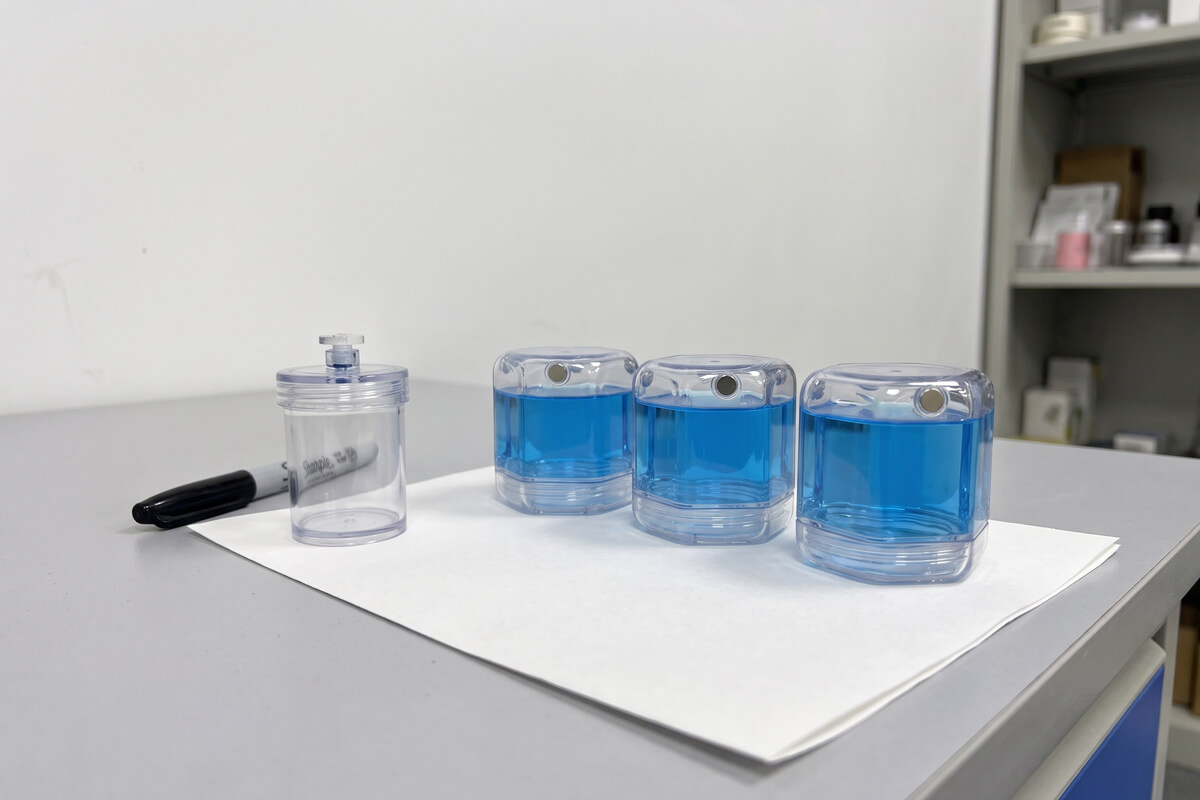
Tooling Cost & MOQ Breakdown for Startups
Capsules are roughly macaron-sized, so the mold blocks are small. That makes them a good fit for bridge tooling in aluminum or soft steel, which cuts both cost and lead time compared with hardened multi-cavity production tools. You can upgrade to steel once the product sells. Treat these figures as planning ranges; DFM fixes the real numbers.
| Item | Planning range (USD, EXW) |
|---|---|
| Body + cap tooling, bridge tool, 1–2 cavities | $6,000–$15,000 |
| Magnet pocket fixtures and assembly jig | $1,000–$3,000 |
| Assembled capsule at 1,000–3,000 pcs (resin, molding, magnets, seal, assembly) | $1.00–$2.00 each |
| Standard MOQ | 1,000 pcs per item, color counted separately |
Headline mold prices of a few thousand dollars usually cover one simple part. A threaded body and cap with magnet features is a different job. MUD rapid tooling can deliver first samples in as little as 10 days.
Six capsules at about $1.30 each is roughly $8 in parts, perhaps $14–$18 landed once you add a tray, box and freight. Against a $45 set price, that leaves room for marketing, platform fees and returns, which is why this is a workable first product for a small brand. For a fuller view of what drives price, see our guide to injection mold cost. We sign an NDA before you share drawings, and you own the mold 100% after full payment.
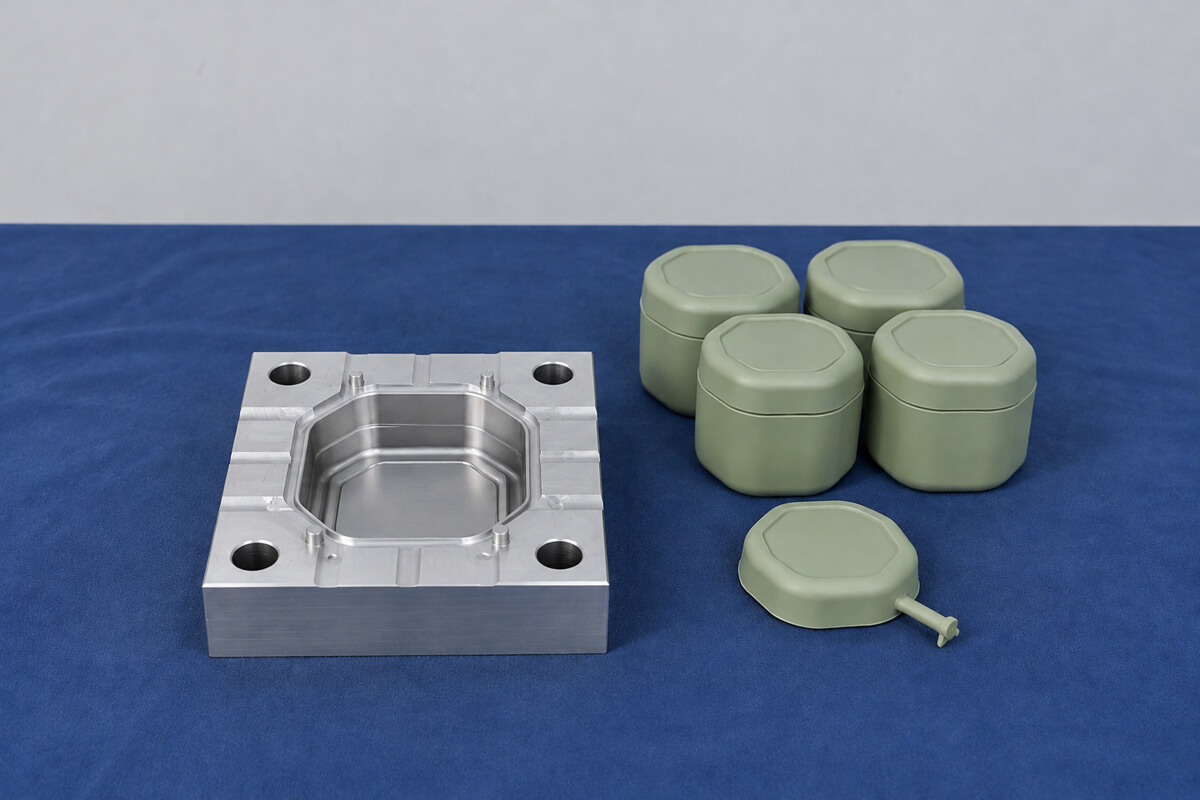
The takeaway: a premium magnetic capsule is a tolerance and assembly problem, not an electronics one. Choose a molder who talks about thread start angles, magnet grades and seal compression before they quote.
Frequently Asked Questions
What materials are magnetic travel capsules made from?
Most are made from PP, PETG, Tritan-type copolyester or PCR resin.
- Mineral-filled PP: lowest cost, matte and heavy feel.
- PETG or Tritan: clear, tough, glass-like look.
- PCR resin: recycled-content claims for eco-minded buyers.
How are magnets embedded in injection molded containers?
Magnets are sealed in plastic using one of two methods.
- Insert molding: the magnet is placed in the mold and plastic flows around it.
- Pocket and ultrasonic weld: the magnet sits in a molded pocket under a welded cover.
What is the minimum order for custom travel capsules?
Our standard MOQ is 1,000 pieces per item, with each color counted separately. Tooling is a one-time cost on top of that.
How do you stop refillable travel capsules leaking on a plane?
Control thread tolerance and add a compressible seal.
- Keep thread and sealing diameters round and within tolerance.
- Use a food-grade silicone or TPE gasket at 15–25% compression.
- Test samples inverted for 24 hours and under vacuum.