

A founder brings us a design that’s already been through two rounds of prototyping — vacuum cast in a urethane resin that felt exactly like the ABS housing they were planning to ship. Then the first injection molded samples come back slightly stiffer, slightly more brittle at one corner, and the snap-fit that worked fine on every cast prototype now cracks on the fifth cycle. Nothing was actually wrong. The two materials were never the same thing; they were just close enough to look identical until the part got tested past what “close enough” covers.
That gap is worth understanding before it costs a design iteration. Materials used across casting and injection molding aren’t just different formulations of the same idea — they’re built for entirely different jobs, one for proving a design works and one for shipping it at scale. Here’s how the materials actually break down across both processes, and where the line sits between “good enough to validate a design” and “good enough to ship.”
Vacuum Casting Materials: Simulating Production Plastics Without Steel Tooling
Vacuum casting pours a two-part polyurethane resin into a silicone mold built from a master pattern, under vacuum to pull out air bubbles before the resin cures. No steel, no CNC mold machining — just a flexible tool that can reproduce a design in a matter of days instead of the weeks a production mold takes. The trade-off is mold life: a typical silicone tool is good for roughly 20 to 25 parts before the cavity detail starts degrading, which is exactly why casting belongs in the prototype and low-volume column, not the production column.
What makes casting genuinely useful, rather than just fast, is that the resins are formulated to simulate specific production plastics rather than being one generic material. Renishaw’s vacuum casting materials range is a good example of how granular this gets — separate resin grades formulated as ABS-type transparent, PC/ABS-type, variable-hardness PP/PE-type, and flame-retardant ABS-type, alongside soft rubber-type grades running anywhere from roughly 20 to 90 Shore A.

This is the material family that makes sense for validating fit, cosmetics, and rough handling before a design is frozen — which is exactly the stage our rapid prototyping process is built around, often ahead of committing to a vacuum casting run for early customer demos, crowdfunding shots, or a first round of user testing.
Injection Molding Thermoplastics: The Material Families You’ll Actually Choose Between
Once a design is heading toward production, the material conversation shifts from “what simulates this plastic” to “which actual thermoplastic resin.” Nearly every injection molding material choice falls into one of three families.
Commodity resins are the default until a part needs something they can’t deliver — higher heat resistance, tighter dimensional precision, or long-term fatigue resistance under repeated flexing, all of which push the choice toward an engineering-grade resin instead. Elastomers rarely stand alone; they’re typically paired with one of the other two families as a soft-touch or sealing layer, which is its own process with its own material-compatibility rules — our overmolding guide covers how TPE and TPU actually bond to a rigid substrate.

When Does a Cast Resin Stop Being “Close Enough” to Production Plastic?
Cast urethane resins are formulated to match the look, feel, and rough mechanical behavior of a target thermoplastic — not to be that plastic. They’re generally hand-mixed in small batches, which introduces more shot-to-shot property variation than an injection molding machine’s repeatable, closed-loop process ever would. They also tend to have shorter fatigue life under repeated flexing, less UV and long-term heat stability, and a shorter service life than the true resin they’re simulating. A living hinge or a snap-fit is a particularly common place for this gap to show up: cast urethane can flex convincingly for the first few dozen cycles a reviewer tries by hand, then fail well short of the fatigue life the actual production resin would deliver under the same repeated stress. None of that matters for checking fit, cosmetics, or first-impression handling. All of it matters the moment a part has to survive real use.

~1–50 units
~500–10,000 units
10,000+ units
Treat casting as the stage that answers “does this design work,” and injection molding — sometimes by way of a lower-cost rapid tool first — as the stage that answers “does this material hold up.” Skipping straight from a cast prototype to a full production tool without testing real injection-grade samples is how a snap-fit that survived a hundred cycles in urethane ends up failing at cycle five in the actual production resin, and by then the cost of finding out has gone up considerably; our breakdown of mold cost drivers is worth a look before locking in a full production tool on an unvalidated material assumption.
Frequently Asked Questions
What’s the difference between molding and casting?
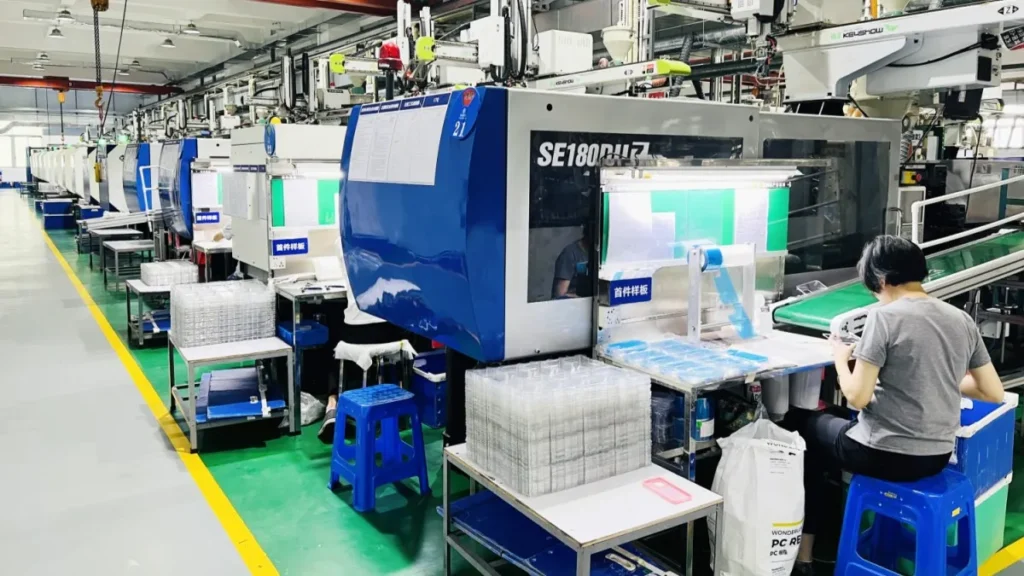
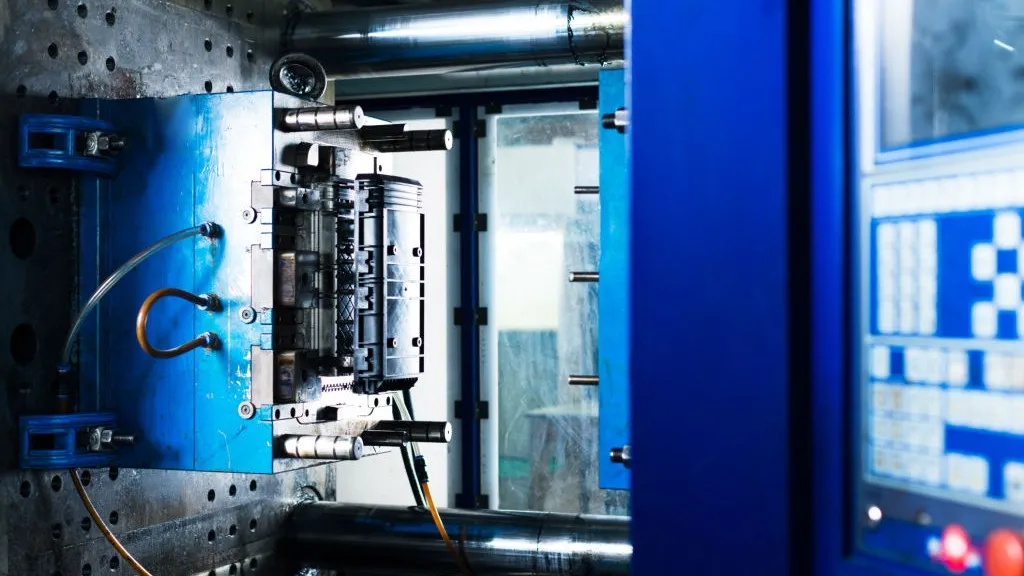
Injection molding forces molten plastic into a hard steel or aluminum mold under high pressure, using an injection molding machine. Casting, in the vacuum casting sense used for prototyping, pours a liquid resin into a flexible silicone mold under vacuum rather than pressure. Molding tooling is expensive but essentially permanent; casting tooling is cheap but wears out after roughly 20 to 25 parts.
What materials are used in vacuum casting?
Vacuum casting uses two-part polyurethane resins formulated to simulate specific production plastics, including:
- Rigid ABS-type resins, including transparent and flame-retardant variants
- PC-simulating resins for tougher, semi-clear parts
- PP/PE-simulating resins with variable hardness
- Soft rubber-type resins across a wide Shore A hardness range
Can cast parts be used as final production parts, or only prototypes?
Mostly prototypes and low-volume runs. A silicone mold’s roughly 20-to-25-part lifespan and the material property differences from true injection-grade resin make casting a poor fit for ongoing production, though some businesses do use it deliberately for genuine low-volume end-use parts — display models, trade show units, or a small first batch — where the volume never justifies steel tooling in the first place.
What plastic materials are most common in injection molding?
ABS, polypropylene (PP), and polycarbonate (PC) cover the large majority of consumer and industrial parts, backed by nylon (PA) where wear resistance or strength matters and POM (acetal) where precision and low friction matter, such as in gears and small mechanisms. TPE and TPU show up wherever a soft-touch grip or a watertight seal is needed alongside one of the rigid resins.
How do you choose between injection molding and vacuum casting for a new product?
Expected volume is the main driver. Under roughly 50 units, or when the design might still change, vacuum casting gets a usable part in hand fastest and cheapest. Once volume climbs into the thousands, or the part needs to be tested in its actual production material, injection molding — via rapid tooling first if the design isn’t fully locked — becomes the more cost-effective and representative path.

- Send us the part geometry and design files
- Tell us your target volume and timeline
- Flag whether cost, speed, or long-term durability matters most