
Every few weeks, a buyer sends over a CAD file and asks the same question: how much will this mold cost? The honest answer is that it depends — but not in a vague way. Injection mold pricing follows fairly predictable logic once you know which variables actually move the number, and by how much. A basic single-cavity prototype tool might run $1,500 to $3,000. A production-grade, multi-cavity steel mold can pass $80,000 before a single part ships. Neither figure is wrong. They’re just answering different questions.
Below is how tooling cost actually breaks down, where a mold’s price tag really goes, and the three places buyers most often get burned: unclear fees, substituted steel, and disputed mold ownership.
What Actually Drives the Price of an Injection Mold
Six variables set the number on a tooling quote, and they interact more than most buyers expect.
- Cavity count — one cavity produces one part per cycle; four cavities produce four, but the mold base, cooling layout, and machining hours all scale up with it.
- Mold base material — aluminum machines faster and costs less upfront; hardened tool steel costs more but survives far more production cycles.
- Part geometry — undercuts, snap-fits, and side holes need sliders or lifters, which are moving mold components that add design and machining time.
- Tolerance requirements — holding ±0.05 mm instead of ±0.15 mm means slower machining passes and more inspection time.
- Surface finish — a textured or mirror-grade finish adds hand-polishing hours that a standard finish doesn’t need.
- Mold size and tonnage — bigger parts need bigger steel blocks, bigger presses, and proportionally more machine time.
We walk new customers through each of these trade-offs during our precision mold-making process, before a single cut is made on the steel — it’s a lot cheaper to change a decision on paper than after the block is machined.
Typical Price Ranges by Mold Type
| Mold Type | Typical Cost | Best For |
|---|---|---|
| Aluminum prototype (1 cavity) | $1,000 – $5,000 | Design validation, under ~10,000 units |
| Single-cavity steel (P20) | $5,000 – $15,000 | 50,000 – 300,000 units |
| Multi-cavity steel (2–8 cavities) | $15,000 – $60,000+ | High-volume production, tight cycle times |
| Complex / multi-material tooling | $60,000 – $150,000+ | Overmolding, IMD, multi-shot parts |
If you need parts before committing to a full production tool, our MUD rapid tooling program reuses a standardized mold base across projects, which typically cuts the starting cost by around 30% and gets first samples to you in as few as 10 days.
Where the Money Actually Goes
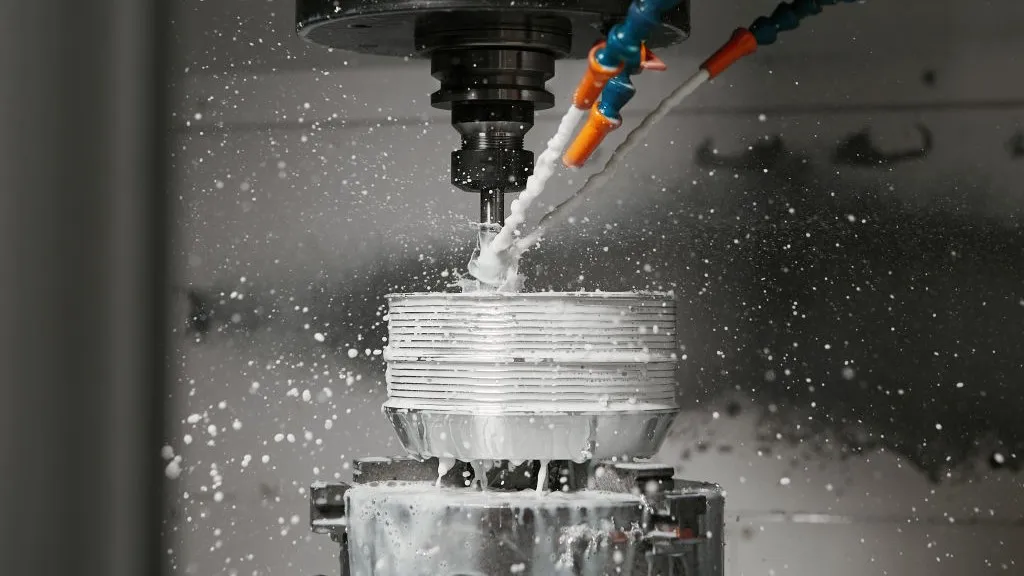
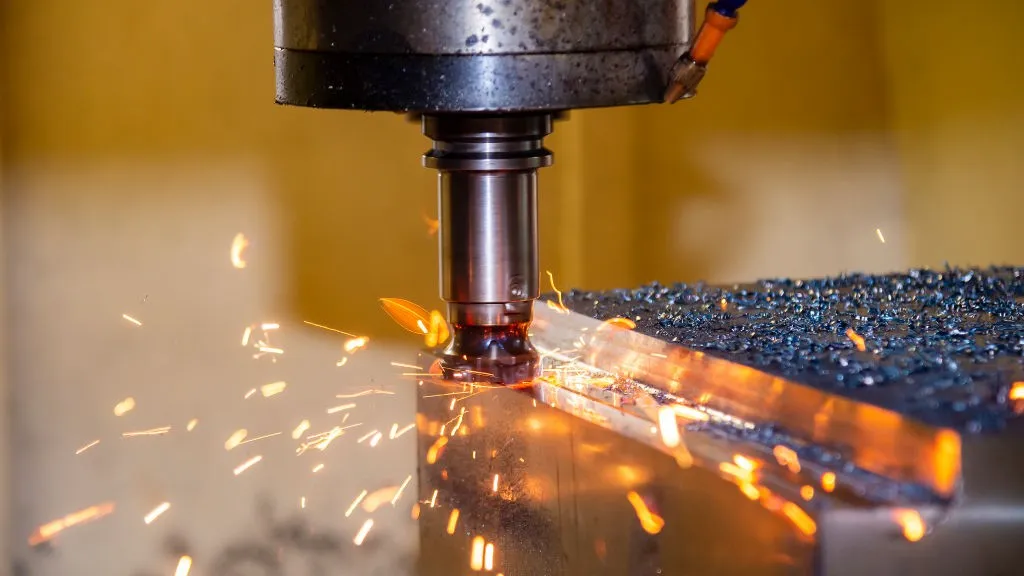
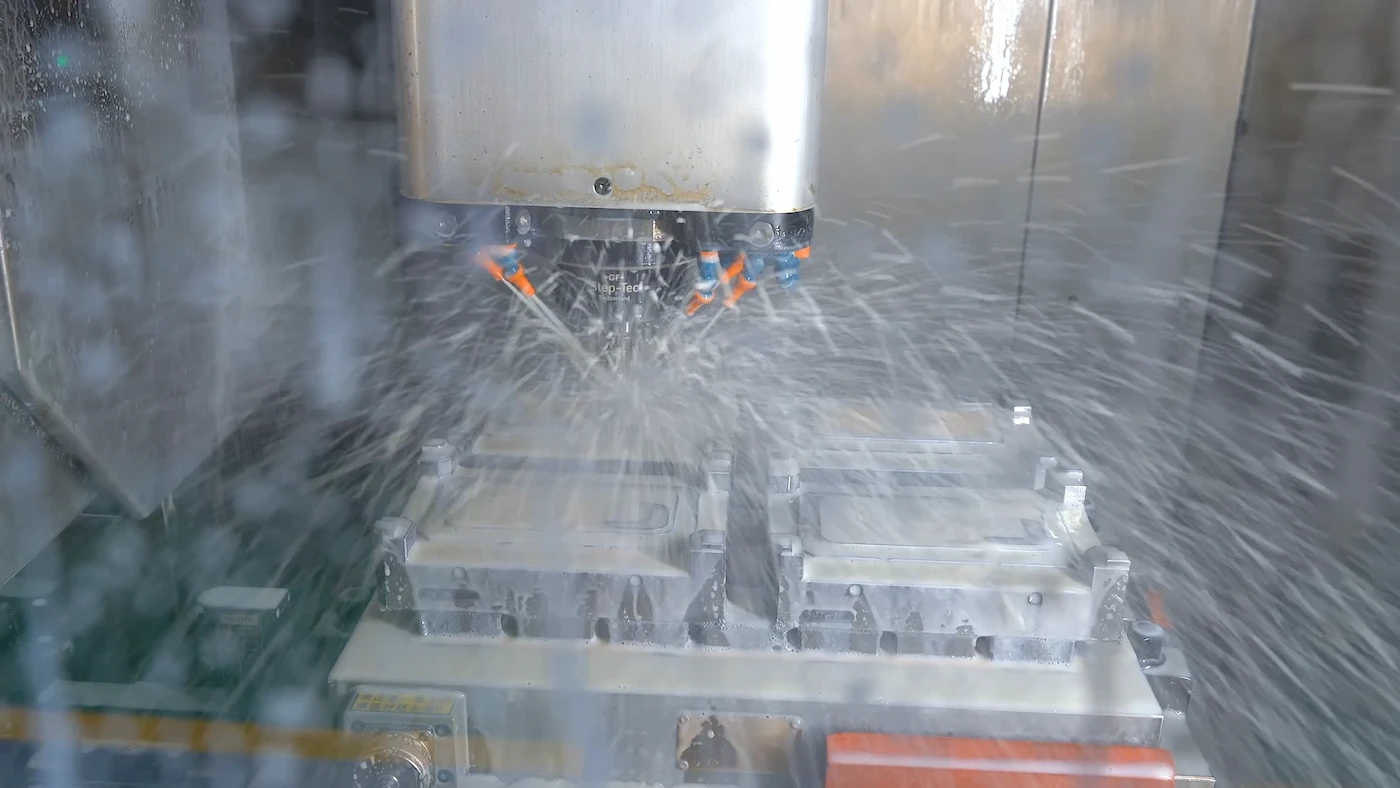
Buyers who see a five-figure quote for what looks like “a block of metal” often assume they’re being overcharged. Usually they’re not. A single cavity insert typically takes 80–150 hours of combined CNC, EDM, and bench work before it ever touches plastic:
- CNC roughing removes the bulk of the steel or aluminum block down to the rough cavity shape.
- EDM (electrical discharge machining) burns in the internal corners, ribs, and fine details a rotating cutter physically can’t reach.
- Heat treatment hardens steel cavities so they can resist wear over hundreds of thousands of cycles.
- Hand polishing brings the surface up to spec, from a light stone finish to a mirror-grade optical finish.
- T1 trial runs produce the first real parts off the mold — which is when dimensional and cosmetic issues actually surface.
A 2025 procurement-focused pricing guide for engineers flagged incomplete part information at quoting time as one of the most common causes of cost overruns partway through a tooling project — which is exactly why a real DFM review before quoting saves money later, not just headaches. (Source: Jaycon, 2025 Injection Moulding Price Guide)
Mold Steel Grade Comparison: P20 vs. NAK80 vs. S136
This is where buyers get shortchanged most often, usually without knowing it. Steel grade is easy to misstate on a quote and hard for anyone outside a machine shop to verify after the fact.
| Steel Grade | Hardness | Typical Life | Best For | Relative Cost |
|---|---|---|---|---|
| P20 | Pre-hardened 28–32 HRC | Up to ~300,000–500,000 shots | Prototypes, general-purpose, low-to-mid volume | Baseline |
| NAK80 | Pre-hardened 37–43 HRC | 1,000,000+ shots | Cosmetic / optical parts, mirror finish | +15–20% |
| S136 | Through-hardened 40–50 HRC | 1,000,000+ shots | Corrosive environments, glass-filled resins | +20–30% |
The gap matters more than the steel names suggest. Mold shops sometimes quote NAK80 or S136 and deliver a lower-grade nitrided P20 substitute, especially on price-sensitive orders. It’s rarely obvious in the first few thousand shots. It becomes obvious around shot 15,000, when a mold rated for glass-filled nylon starts showing flash and dimensional drift, because the cavity wasn’t hard enough for the abrasive fiber content. If your resin has 20% or more glass fill, confirm the actual steel grade and hardness reading in writing — not just the name printed on the quote.
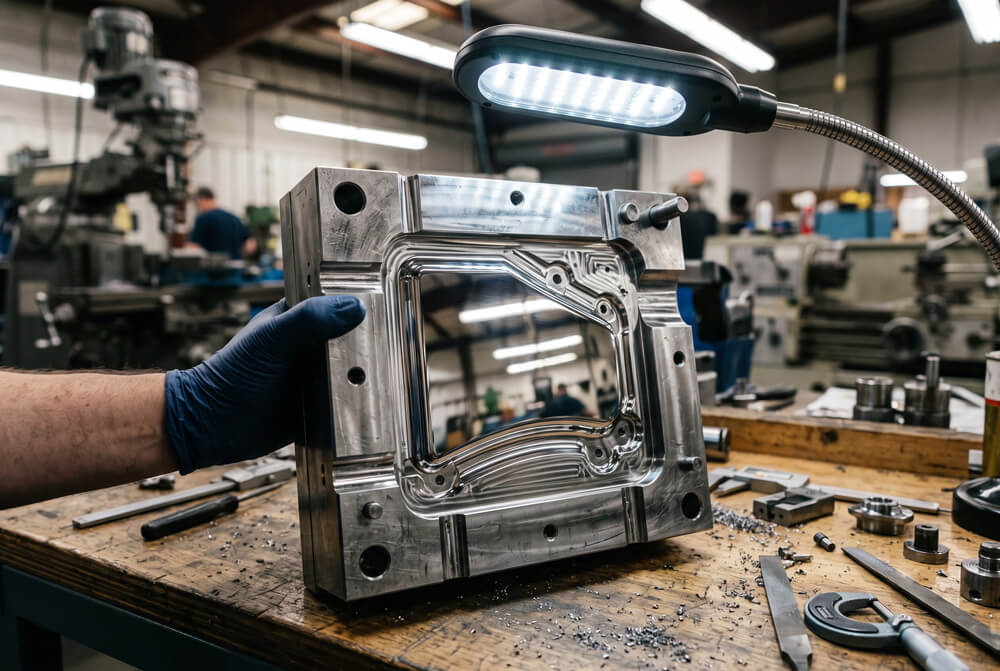
We back every mold with a materials certificate and inspection record as part of our ISO 9001-certified quality assurance process, so the steel grade on your purchase order is the steel grade actually cut into your mold.
A mold quote isn’t one number — it’s tooling, DFM, T1 sampling, modifications, packaging, and freight. Ask for all six, itemized, before you sign.
Hidden Fees to Watch for in a Supplier’s Quote
The tooling line item is rarely the final number. These are the charges that tend to show up later, usually with less notice than buyers would like:
- DFM revision fees — some suppliers requote from scratch after every design change, even minor ones.
- T1 sample fees — the first trial shot-off is sometimes billed separately from the base tooling price.
- Mold modification fees — post-T1 engineering changes are billed per change, and rates vary widely between suppliers.
- Export packaging — ISPM-15-certified wooden crates and fumigation add cost that not every quote discloses upfront.
- Freight, duties, and tariffs — ocean freight and any applicable import tariffs are usually the buyer’s responsibility, but the split isn’t always clear until the invoice arrives.
- Mold storage fees — if production isn’t continuous, some suppliers charge to keep your mold on their shelf between runs.
None of these are inherently unfair. What’s unfair is finding out about them after the tooling payment has already gone out. Ask for a single itemized quote covering all six before you commit — our custom plastic injection molding quotes list each of these separately by default, specifically so nothing shows up as a surprise later.
Who Owns the Mold After You Pay the Tooling Fee?
This is the question that matters most and gets asked least — usually until it’s too late. Paying the full tooling invoice doesn’t automatically mean you own the mold outright, or that you’re free to move it to another factory if the relationship sours. Some suppliers treat the tooling payment as a manufacturing deposit rather than a purchase, and keep the mold — and its CAD data — on their own floor indefinitely.
Before paying a deposit, get the following in writing:
- A clear ownership clause stating the mold and embedded IP transfer to you on final payment
- The right to have the mold shipped or transferred to a different manufacturer at any time
- Delivery of 2D drawings and 3D CAD/CAM files, not just the physical tool
- Written storage terms if the mold stays on-site between production runs
At YG, once the tooling balance is paid, the mold and its design files belong to you — full stop. If you ever need to move production, we ship the mold or hand over the files directly, no negotiation required. If a supplier can’t answer this question in writing before you pay a deposit, treat that as your answer. Talk to our engineering team before you sign anything you’re not sure about.
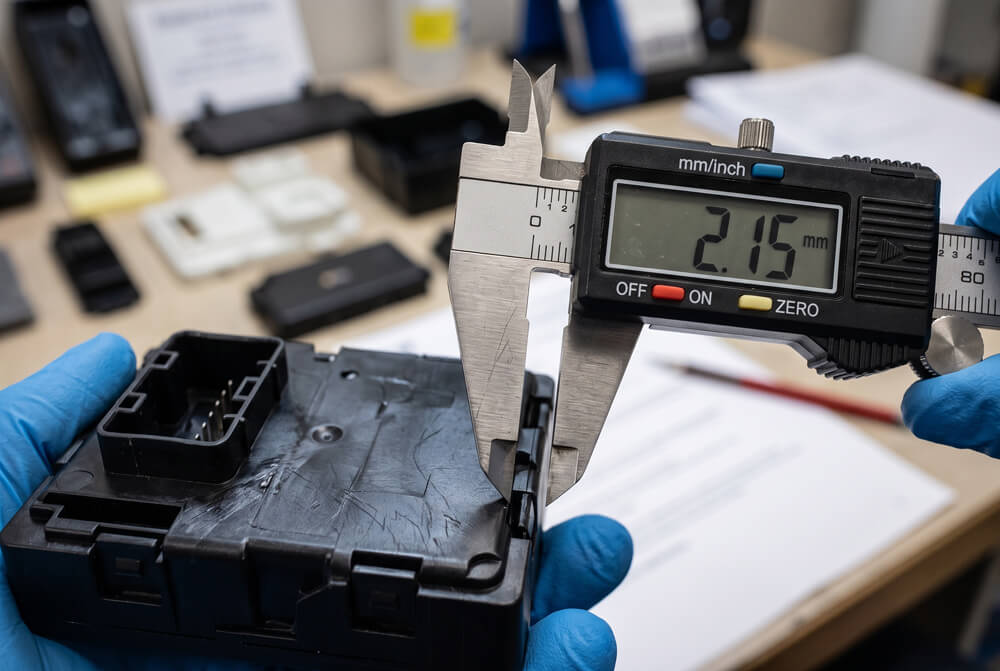
Tooling cost is a real number with real machining time behind it, not an arbitrary markup. Once you know what’s driving it, a quote stops being a mystery and starts being something you can actually negotiate on the right terms.
Frequently Asked Questions
How much does a simple injection mold cost?
A simple single-cavity aluminum mold typically costs $1,000–$5,000.
- Aluminum prototype tools: $1,000–$5,000, good for under ~10,000 shots
- Single-cavity P20 steel mold: $5,000–$15,000, good for 100,000+ shots
- Cost rises with part size, undercuts, and tolerance requirements
Why are plastic injection molds so expensive?
Mold cost reflects precision machining time, not just raw material.
- CNC roughing and EDM burning for internal ribs and corners
- Heat treatment and hardening for long-term wear resistance
- Hand polishing to the required surface finish
- Engineering hours for DFM review and T1 sampling
What is the cost difference between aluminum and steel injection molds?
Aluminum molds cost roughly 30–50% less than steel molds of the same design, but last for a fraction of the cycles.
- Aluminum: lower upfront cost, faster to machine, rated for roughly 1,000–50,000 shots
- Steel (P20/NAK80/S136): higher upfront cost, rated for 300,000–1,000,000+ shots
- Aluminum suits validation and low-volume runs; steel suits production above roughly 10,000–20,000 units
Is injection molding cheaper than 3D printing for low volumes?
Not usually below 200–1,000 units, depending on part size and material.
- 3D printing has no tooling cost, so per-part price stays roughly flat
- Injection molding requires upfront tooling investment, but per-part cost drops sharply afterward
- For most small plastic parts, the break-even point falls between roughly 200 and 1,000 units
- Below that volume, 3D printing or CNC machining is usually the cheaper overall choice
How much does a multi-cavity mold cost compared to a single-cavity mold?
A multi-cavity mold typically costs 1.5–3x more than a single-cavity mold of the same part.
- Each added cavity increases machining time, mold base size, and cooling-channel complexity
- A 4-cavity mold might run roughly 2x a single-cavity mold’s price, while cutting per-part cost significantly
- Multi-cavity tooling typically pays off once annual volume exceeds about 20,000–50,000 units
How do you calculate cost per part in injection molding?
Cost per part = tooling amortization + material cost + machine time cost + labor + scrap allowance.
- Tooling amortization: mold price divided by expected lifetime production volume
- Material cost: resin price per kg × part weight, plus runner waste
- Machine/cycle cost: hourly machine rate × cycle time, divided by cavity count
- Labor and secondary operations: assembly, packaging, inspection
- Scrap allowance: typically 3–5%, added to cover rejects
Not sure where your part lands on this pricing scale?
Send your CAD files and target volume — our engineering team will return a DFM report, steel-grade recommendation, and itemized tooling quote, usually within 48 hours.
Get a Free DFM Review