
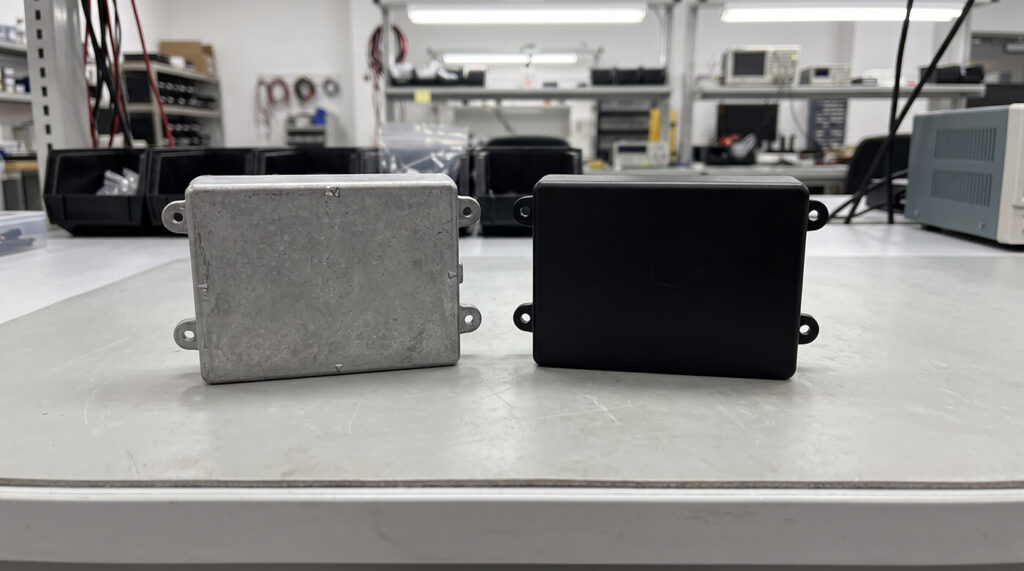
Every few months a buyer comes to us with the same starting question, phrased differently: “our part is currently die cast — can we move it to plastic and cut cost?” Sometimes the answer is an easy yes. Sometimes it’s a firm no, and the reason isn’t cost at all — it’s stiffness, heat, or a mold that was never going to survive the volume they actually need. This piece breaks down where each process genuinely wins, using the numbers that should drive the decision rather than a generic “metal is stronger” assumption.
The Real Dividing Line: Material Class, Not Just Process
The most basic distinction gets lost surprisingly often: die casting and injection molding aren’t two ways of making the same thing — they’re built around fundamentally different material classes. Die casting injects molten non-ferrous metal — almost always aluminum, with zinc and magnesium as the other common choices — into a hardened steel die under high pressure. Injection molding injects molten thermoplastic (and occasionally thermoset) resin into a mold under comparable pressure but at a fraction of the temperature. Aluminum die casting alloys melt and get poured around 650-700°C; most engineering thermoplastics process in the 200-320°C range.
That temperature gap is the root cause of almost every other difference between the two processes — mold material requirements, mold lifespan, cycle time, and the finishing work needed afterward all trace back to it. Once you know which material class your part actually needs — conductive, load-bearing metal, or an insulating, moldable-to-net-shape polymer — the “which process” question is mostly already answered. The harder question, and the one worth real engineering time, is whether your part’s requirements are actually metal-only, or whether they only look that way because the original design was never re-evaluated against modern engineering plastics.
Strength-to-Weight: When Glass-Filled Plastic Can (and Can’t) Replace Aluminum
This is where most metal-to-plastic replacement conversations either succeed or fall apart, and the confusion usually comes from looking at the wrong property.
On raw tensile strength relative to weight, glass-filled nylon looks surprisingly competitive. A typical A380 aluminum die casting alloy has an ultimate tensile strength around 324 MPa at a density of 2.71 g/cm³. A 50%-glass-filled PA66 (PA66-GF50), dry as molded, can reach 180-210 MPa at a density of roughly 1.57 g/cm³. Run the specific-strength math (strength divided by density) and the two materials land in a similar range — which is exactly the number that gets pulled into a sourcing deck to justify a switch to plastic.
The problem is that specific strength isn’t the property that usually fails first in a structural enclosure. Stiffness — resistance to deflection under load — is, and that’s where the gap is much larger. Aluminum has a tensile modulus around 69-71 GPa; PA66-GF50 sits around 10-14 GPa, roughly five to seven times lower. In practice, that means a plastic part carrying the same load as its aluminum equivalent will flex or deflect noticeably more unless the wall thickness and rib structure are redesigned to compensate — not just swapped material-for-material on the existing geometry. Add in that nylon absorbs ambient moisture and its mechanical properties shift meaningfully between dry-as-molded and moisture-conditioned states, and a part that tests fine on day one in a lab can behave differently after months in a humid environment.
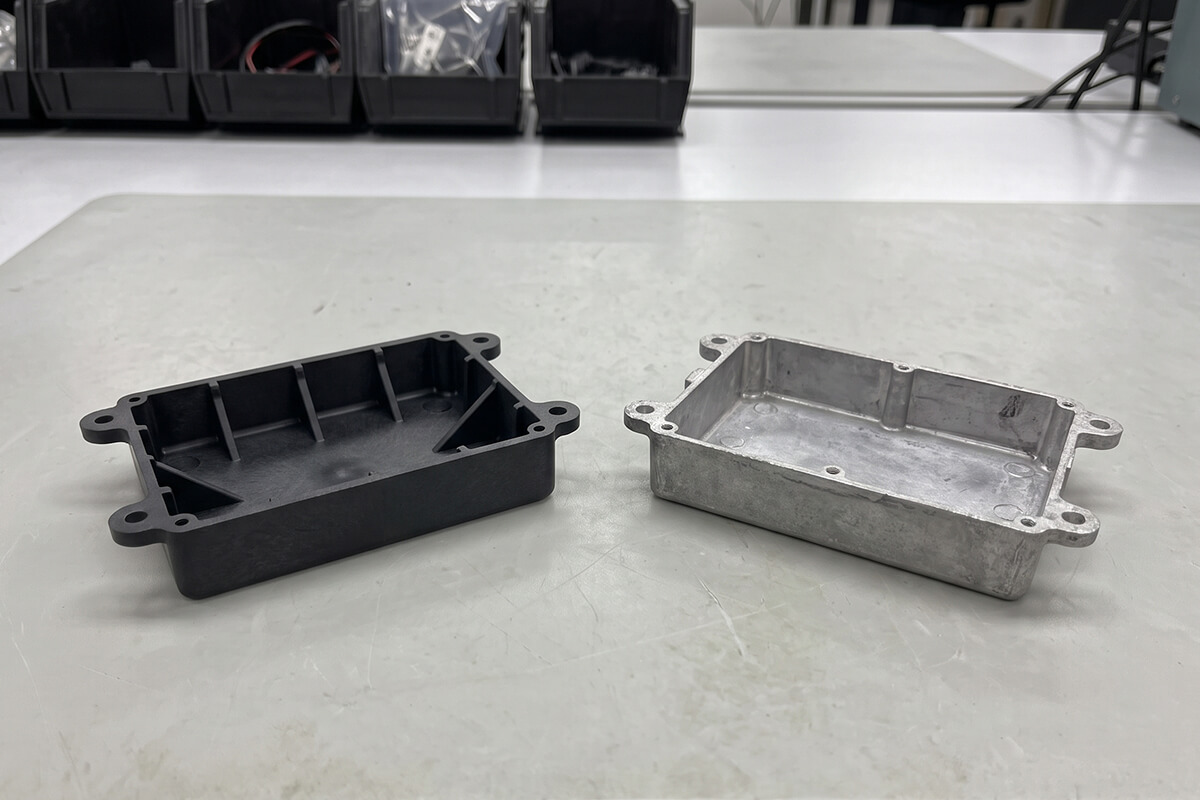
None of this rules plastic out. It means the strength-to-weight conversation has to include a real deflection and creep analysis against your actual load case and environment, not a single tensile number pulled from a datasheet. Where it usually works well: enclosures and brackets carrying moderate, well-distributed loads with generous wall thickness and ribbing to compensate for lower stiffness, often utilizing structural-grade plastic to bridge the mechanical gap. Where it usually doesn’t: thin-wall structural parts under sustained or impact load where deflection itself is the failure mode, not fracture.
Thermal Conductivity and EMI Shielding: When They’re Worth Die Casting’s Price Premium
Aluminum conducts heat at roughly 150-200 W/m·K. Unfilled engineering plastic sits around 0.2-0.3 W/m·K — three orders of magnitude lower. Thermally conductive plastic compounds close some of that gap, but even aggressive filler loadings typically land in the 1-20 W/m·K range, still far below metal. For a part that’s genuinely acting as a heat sink — pulling heat away from a power component and dissipating it to ambient air — die cast aluminum is usually doing real thermal work that plastic can’t match without a much larger surface area or an added metal insert.
EMI shielding follows a similar logic but for a different reason: aluminum and zinc are naturally conductive, so a die cast housing shields electromagnetic interference simply by existing. Plastic is an electrical insulator by default and provides zero shielding unless something is done to it — a conductive coating (vacuum-metalized, sprayed, or plated), a conductive filler compounded into the resin, or a metal shield/gasket added as a secondary component. Each of those options adds a process step, a cost line, and in some cases a documented shielding-effectiveness spec that has to be re-verified if the coating supplier or formulation changes — a smaller-scale version of the same certification risk we cover in material selection generally.
So the real decision isn’t “does this need shielding,” it’s “does this need shielding at a level and reliability that’s cheaper to build in via aluminum’s inherent conductivity than to add onto plastic afterward.” For enclosures with moderate shielding requirements and enough interior volume to add a coating, plastic-plus-coating is frequently the lower-total-cost path, especially at volumes where die casting’s higher unit cost never gets diluted enough by tooling amortization.
Industry Resource For a detailed breakdown of how shielding requirements impact production economics, refer to Boothroyd Dewhurst’s 2025 Die Casting vs Injection Molding: Cost and Design Comparison.
Mold Life and Total Cost of Ownership: The Hidden Re-Tooling Risk in Long-Run Die Casting
This is the number that gets left out of most first-pass sourcing comparisons, and it’s the one that changes the math most on long production runs.
A die casting die is repeatedly exposed to molten aluminum at 650-700°C and then rapidly cooled every cycle, which drives thermal fatigue in the tool steel — the same stress-and-relax cycle, thousands of times over, eventually causes heat checking (fine surface cracking) and localized cracking that degrades part quality and eventually requires the tool to be reworked or rebuilt. Depending on the alloy, part geometry, and tool steel grade, aluminum die casting dies commonly need significant rework or reach end of usable life somewhere in the range of 100,000 to 250,000 shots, with some high-stress applications seeing meaningful degradation well before that.
A hardened injection mold steel, by contrast, isn’t subjected to anywhere near that thermal shock — plastic processes at a fraction of the temperature, and the wear mechanism is closer to gradual abrasion than repeated thermal cracking. Injection molds routinely run 500,000 to over 1,000,000 cycles before significant rework, particularly with hardened steel and unfilled or lightly filled resins.
For a program quoting a few thousand units, this difference barely matters. For a program planning several hundred thousand units a year over a multi-year product life, it changes the total cost of ownership significantly: a die casting program may need a full tool rebuild, or at minimum a costly steel repair and re-qualification cycle, mid-program — a reset cost that rarely appears in the initial tooling quote, since it depends on a production volume and timeline that isn’t always modeled at the RFQ stage. Toolmakers sometimes describe this as the “cost iceberg” of die casting tooling: the visible tooling quote is only the portion above the waterline, with die maintenance, heat-treatment quality, and thermal fatigue resistance sitting underneath it and driving the real long-run number (Source: Uddeholm technical guidance on die casting tool steel).
The practical takeaway for anyone comparing quotes: ask any die casting supplier directly what shot count their quoted tool steel and heat treatment are rated for at your part’s geometry and wall thickness, and get that number in writing before treating the tooling quote as final. If your volume forecast realistically exceeds that number within the product’s life, budget for a mid-program tool investment now rather than discovering it later.
Frequently Asked Questions
What is the primary difference between die casting and injection molding?
Die casting forms parts from molten non-ferrous metal — usually aluminum, zinc, or magnesium — while injection molding forms parts from molten thermoplastic or thermoset resin. That material difference drives almost everything else: die casting needs hardened steel tooling to survive metal temperatures around 650-700°C, while injection molding tools handle plastic at 200-320°C, resulting in longer tool life, lower part weight, and no inherent electrical conductivity compared to die casting.
Is die casting more expensive than plastic injection molding?
Generally, yes, on both ends of the cost curve. Die casting tooling typically costs more upfront due to the harder steel and more complex thermal design needed to survive metal temperatures, and the higher-density raw material itself carries a higher per-kilogram cost than most commodity or engineering resins. Die cast parts also frequently require secondary CNC operations — trimming flash, machining precision features, tapping threads — that add labor and lead time an as-molded plastic part usually skips entirely. Where die casting can compete is at very high volumes on simple geometries, where tooling cost amortizes and material efficiency improves; injection molding tends to stay the lower-cost path for complex geometries or moderate volumes.
Which process achieves tighter dimensional tolerances: aluminum die casting or plastic injection molding?
It depends on the feature, not a blanket winner. As-cast aluminum die casting typically holds standard linear tolerances in the range of ±0.1-0.4mm depending on part size, and metal doesn’t suffer from moisture absorption the way nylon does — but it does shrink as it solidifies and can warp on larger, thin-walled geometries. As-molded plastic parts, especially in low-shrink amorphous resins like ABS or PC, can often hold tighter percentage-based tolerances on smaller precision features without secondary machining. Neither process reliably holds true precision-fit tolerances (sub-0.05mm) without a secondary CNC operation — for those features, the real comparison isn’t die casting vs. injection molding, it’s which process needs less machining to get there.
Can plastic injection molding replace die casting to reduce product weight?
Often, yes — aluminum die castings frequently get lighter and cheaper when redesigned in glass-filled engineering plastic, particularly for enclosures, covers, brackets, and housings without extreme thermal or EMI requirements. The key word is redesigned: a successful conversion rarely just swaps material on the existing metal geometry. It usually involves adding ribbing and wall-thickness changes to compensate for plastic’s lower stiffness, reassessing fastening methods (metal often uses tapped holes; plastic typically needs bosses or inserts), and validating the part against real load and temperature conditions rather than assuming metal-equivalent performance.
Why does die casting require more secondary CNC machining than injection molding?
Two reasons, both tied to the physics of the process. First, molten metal injected at high pressure inevitably escapes through the parting line and around moving cores as flash, which has to be trimmed off — plastic flashes too, but far less aggressively and often within acceptable cosmetic limits. Second, die casting struggles to hold precision features like fine threads, flat sealing surfaces, or tight bore tolerances directly from the die, because metal shrinkage and porosity near the surface make those features unreliable as-cast; CNC drilling, tapping, and facing operations clean them up afterward. Injection molding can produce functional threads directly via unscrewing cores or collapsible cores, and holds cosmetic surfaces and moderate-precision features as-molded far more often, which is why a plastic part quote often includes zero secondary machining where a comparable die cast part quote includes several line items for it.
Which process is better for high-temperature and harsh outdoor environments?
For sustained high heat — engine bays, industrial ovens, anything regularly exceeding roughly 150-180°C — die casting is generally the more dependable choice, since aluminum doesn’t soften or creep the way most thermoplastics do as they approach their heat deflection temperature. For UV and weathering exposure specifically, the comparison is closer than it looks: standard plastics like ABS do degrade under prolonged UV exposure, but UV-stabilized resin grades and resins like ASA are formulated specifically to resist yellowing and embrittlement outdoors, while aluminum’s own weak point in harsh environments is galvanic and salt-spray corrosion rather than UV. For a part facing extreme sustained heat, die casting remains the safer default; for a part facing UV and weather but not extreme heat, a properly specified weatherable resin is often a legitimate and lighter alternative.
Ready to Optimize Your Manufacturing?
Let our engineers evaluate your project and find the most cost-effective process.
Request a Quote