
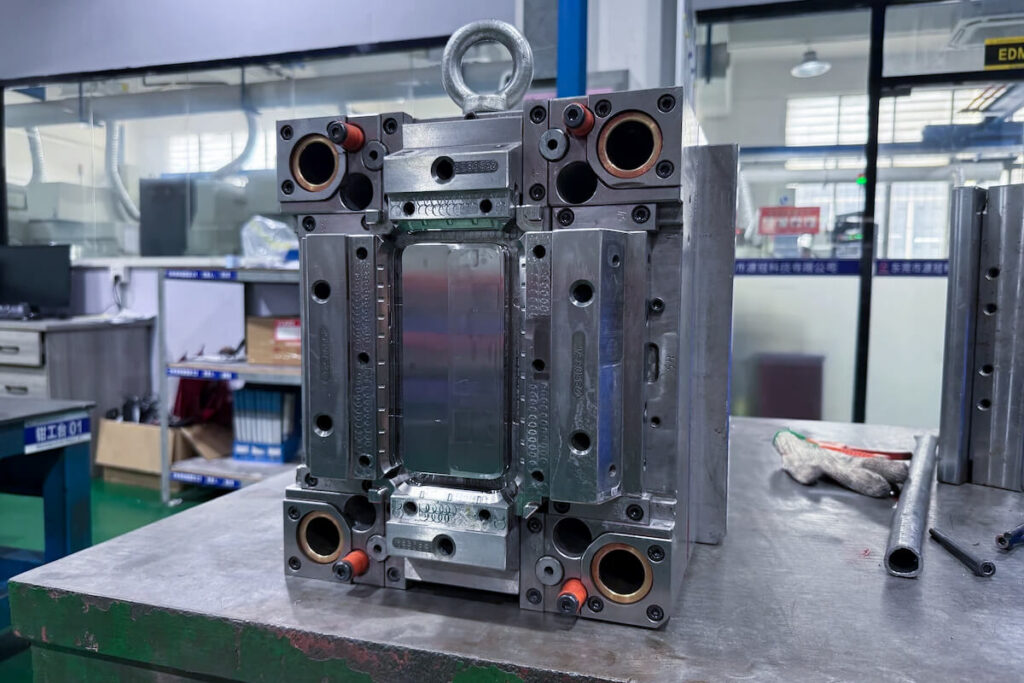
When hardware founders, product engineers, and sourcing managers evaluate plastic injection mold making partners in China, the gap between a smooth commercial launch and a six-week schedule slip rarely comes down to the injection press itself. It comes down to what happens in the toolroom before the first shot of resin is ever melted. Poorly engineered parting lines, unverified steel hardness, and guesswork cooling layouts inevitably scale defects across thousands of parts.
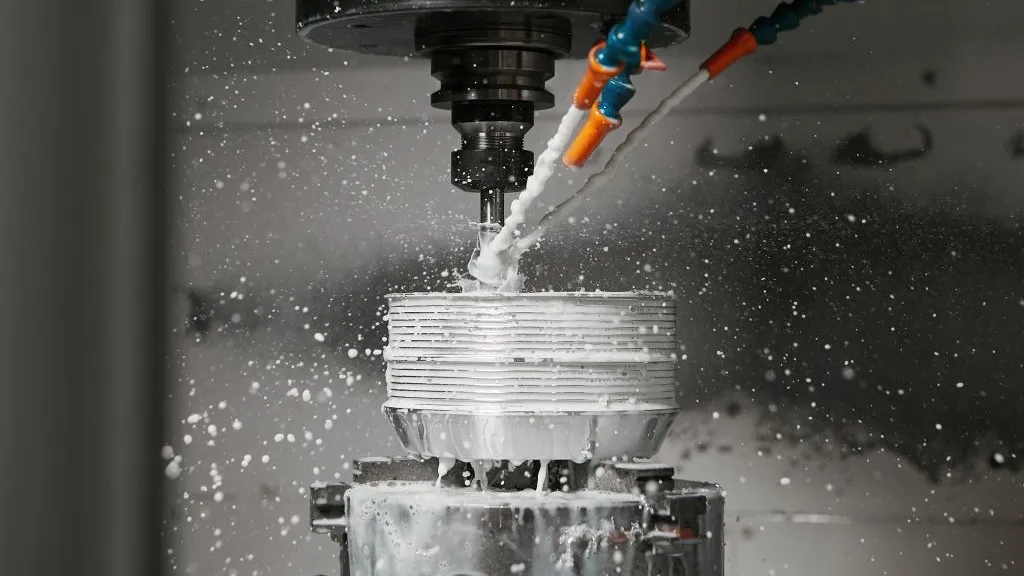
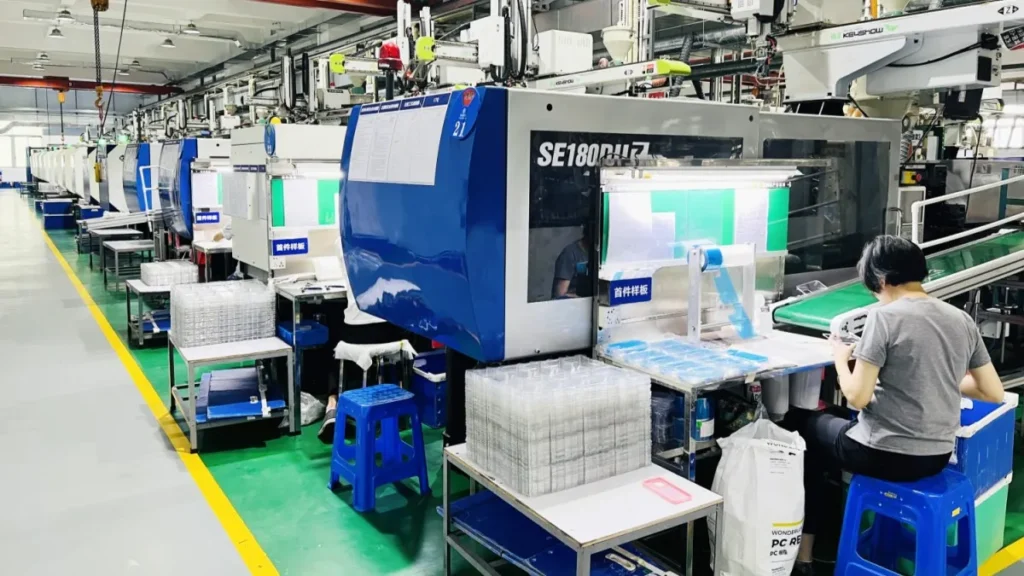
At YG TECH, our mold making methodology is built on empirical rheology data and steel-safe precision rather than trial-and-error tuning. Operating since 1996 with an in-house toolroom and 130+ injection molding machines ranging from 50T to 800T, we engineer tooling specifically tailored for agile Western SMEs, Kickstarter-backed hardware startups, and specialized accessory brands. Whether you are launching a $30+ retail ruggedized smartphone case, an optically clear collectible grading slab protector, an industrial VR/AR headset frame, or a portable medical enclosure, our Makino and Mikron CNC machining centers hold steel tolerances strictly within ±0.01 mm.
Combined with mandatory upfront Design for Manufacturability (DFM) audits, our precision mold making services bridge the gap between rapid 10-day Master Unit Die (MUD) validation inserts and multi-cavity 2K or Liquid Silicone Rubber (LSR) production tooling.
Core Engineering & Commercial Baseline at YG TECH
• Machining Precision: ±0.01 mm tolerances via Makino & Mikron CNC and Mirror EDM
• Rapid NPI Speed: MUD rapid tooling cuts mold costs by 30% with T0 samples in 10 days
• Production Fleet: 130+ presses (50T–800T) plus ISO Class 8 cleanroom molding cells
• Tooling Lifecycle: 300,000 shots standard baseline (upgradeable to 500,000+ shots)
• Specialty Processes: 2K Double-Shot (250T Haitian), LSR/LIM, IMD, IM-3D-E, and PPS resins
• B2B Terms: 1,000 pcs MOQ, EXW/DDP shipping, upfront NDA, and 100% client mold ownership
1. The Data-Driven Plastic Injection Mold Making Workflow
A mold is a high-pressure heat exchanger combined with a precision mechanical assembly. If a toolmaker starts rough-milling P20 or S136 steel immediately upon receiving your 3D STEP file without simulating polymer flow, you will pay for that shortcut during T1 and T2 rework. Our custom plastic injection molding workflow follows a strict five-stage engineering gate system:
Before cutting steel, our engineers analyze wall thickness uniformity, draft angles, undercut slider trajectories, and volumetric shrinkage. We simulate melt-front advancement to relocate weld lines away from high-stress drop zones or cosmetic lenses, and verify gate shear rates for specialty polymers like glass-filled nylon or PPS.
We build the complete 3D mold assembly upon authentic LKM mold bases, integrating YUDO or Mold-Masters hot runners where multi-cavity balance is required. Cooling lines—including conformal channels or Beryllium Copper (BeCu) inserts for tight cores—are mapped to stabilize tool surface temperatures.
Following rough machining and vacuum stress-relief heat treatment (48–52 HRC for hardened steels), our Makino and Mikron CNC centers execute high-speed finishing to ±0.01 mm. Precision wire-cut and mirror EDM form sharp internal corners, shut-offs, and optical SPI A1/A2 or VDI 3400 textured surfaces.
Master toolmakers hand-fit parting line shut-offs on spotting presses until contact exceeds 90%. Once T0 samples are shot in our ISO Class 8 cleanroom or main molding bay, parts undergo Full-Dimension Inspection (FAI) via Coordinate Measuring Machines (CMM) and 2D optical projectors prior to dispatch.
2. Advanced Tooling Capabilities: 2K, LSR, IMD, and IM-3D-E
While single-shot open-and-shut molds handle basic internal brackets, high-value consumer accessories and smart hardware devices require multi-functional integration. If your product retails above $30—such as a MagSafe-compatible protective phone case, a waterproof outdoor GPS tracker, or a child-resistant smart storage case—relying on manual glue assembly introduces high labor costs and field delamination failures.
To eliminate secondary assembly bottlenecks, YG TECH engineers specialized multi-process tooling in-house:
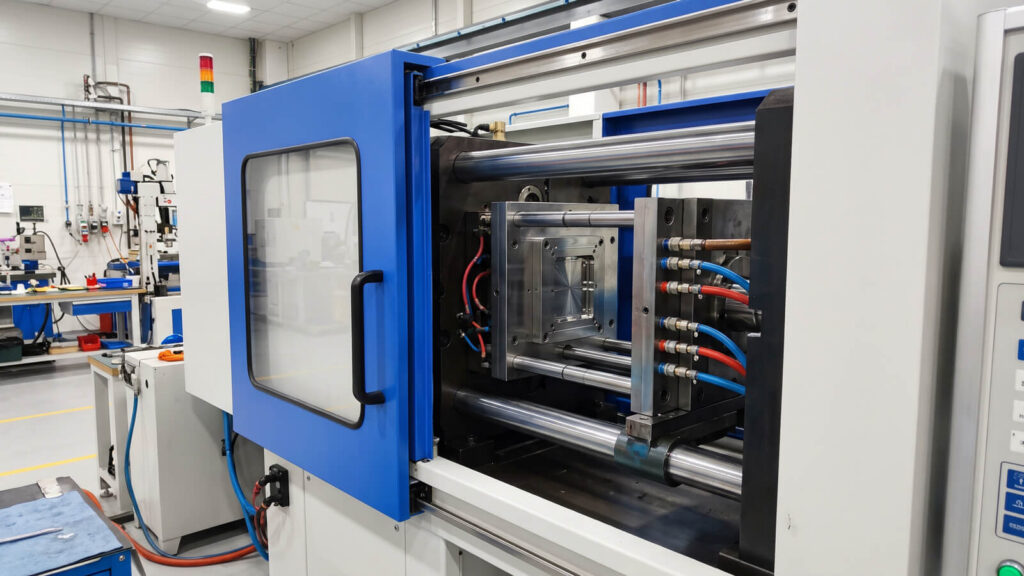
- 2K (Double-Shot) Injection Tooling: We operate dedicated 250T Haitian rotary-platen 2K injection machines engineered specifically for two-shot injection molding. By transferring the rigid substrate (such as PC, ABS, or PA) directly from the first cavity into the second elastomer cavity (TPU or TPE) inside a single automated machine cycle, we achieve a permanent molecular and mechanical bond with zero handling contamination.
- Liquid Silicone Rubber (LSR/LIM) Cold-Runner Molds: For optical-grade wearable seals, hypoallergenic grips, and IP68 waterproof gaskets, we design platinum-cured LSR tooling. Because LSR is a thermoset elastomer with water-like low viscosity that cures under heat, our LSR molds incorporate water-cooled cold runner shut-off nozzles, vacuum cavity evacuation, and flashless parting lines machined to within 0.005 mm.
- In-Mold Decoration (IMD) & IM-3D-E (In-Mold 3D Electronics): For smart home interfaces and sleek wearable housings, our IMD and IM-3D-E tooling integrates pre-printed decorative foils or 3D conductive circuit traces directly into the mold cavity prior to resin injection. Encapsulating capacitive touch sensors, antennas, or LED interconnects directly within the molded wall eliminates discrete PCB mounting brackets, reduces assembly weight by up to 35%, and seals electronics against moisture and vibration.
- High-Performance Specialty Engineering Resins: Beyond commodity thermoplastics, our hot-oil heated molds and wear-resistant screw assemblies routinely process high-temperature specialty resins including PPS (Polyphenylene Sulfide), PEEK-blend compounds, UV-stabilized optical Polycarbonate, and GRS 4.0 certified post-consumer recycled resins.
3. Engineering Case Study: Solving Uneven Wall Thickness in Portable Medical Housings
Real-world industrial designs rarely feature textbook-uniform walls. When aesthetic bevels, structural mounting bosses, and display bezels converge on a single enclosure, thermal imbalances inside the mold can ruin part flatness. Here is how our tooling engineers resolved a severe molding bottleneck for a compact medical monitor housing.
Shop-Floor Case Study: Portable Medical Monitor Enclosure
The Engineering Challenge:
During our preliminary DFM audit of the client’s 3D CAD model, we flagged severe wall thickness transitions across the front bezel and internal boss mounts—ranging from 1.5 mm thin cosmetic flanges up to 4.2 mm heavy structural intersections. Had we cut the S136 steel directly to print, differential volumetric shrinkage would have caused deep cosmetic sink marks on the exterior class-A face, high internal residual stress, and severe corner warpage that prevented the LCD gasket from sealing.
The YG TECH Tooling & Process Solution:
First, our engineers worked with the client to core out heavy internal bosses (reducing rib-to-wall ratios to 55%) without sacrificing screw pull-out strength. Second, we executed multi-iteration Mold Flow simulations to relocate the hot-runner valve gates, equalizing cavity filling pressure across both thick and thin sections. Finally, we engineered a conformal cooling channel layout that closely followed the internal contour of the bezel. By eliminating localized hot spots and holding cavity surface temperature variation within ±1.5°C, we stabilized cycle time and achieved a zero-defect cosmetic and dimensional yield in mass production.
4. Tool Steel Selection and Supply Chain Transparency
One of the hidden risks when sourcing custom molds overseas is unverified steel substitution—where a supplier quotes premium hardened stainless steel but machines low-grade domestic carbon steel that pits, rusts, or loses shut-off sharpness after 20,000 cycles. According to recent industry manufacturing data from Grand View Research, the global injection molded plastics market reached USD 362.5 billion in 2025, with OEMs increasingly prioritizing tooling longevity and documented material traceability to prevent supply chain disruptions (Source: Grand View Research).
At YG TECH, we enforce strict supply chain transparency. Every mold shipment and T0 validation package includes official Steel Mill Material Certificates and heat-treatment hardness logs.
- Authentic LKM Mold Bases: Every production tool is constructed on genuine LKM mold bases to guarantee platen parallelism, guide-pillar rigidity, and global interchangeability.
- Application-Matched Core & Cavity Steels: For rapid validation and mid-volume enclosures, we deploy pre-hardened P20, 718H, or Daido NAK80. For optically clear polycarbonate accessories, medical enclosures, or abrasive glass-filled and flame-retardant polymers, we specify genuine Swedish ASSAB S136 or H13 hardened tool steel. Our standard production molds are engineered for a baseline lifecycle of 300,000 shots, with hardened S136 configurations scaling effortlessly to 500,000+ shots.
- Globally Serviced Hot Runners: When multi-cavity efficiency calls for hot runner manifolds, we exclusively specify internationally supported systems—primarily YUDO and Mold-Masters. Whether your mold runs in our Dongguan facility or is exported to a molding plant in Ohio or Germany, replacement thermocouples, heaters, and valve pins are readily available off the shelf.
5. Cost & Lead Time Drivers: MUD Rapid Tooling vs. Production Molds
For hardware startups and growing SME brands, speed to market and cash-flow preservation are existential metrics. Waiting 8 weeks for a traditional production mold before testing your product with real customers is rarely viable. Conversely, 3D printed SLA or SLS prototypes cannot replicate the true drop-test strength, snap-fit elasticity, or surface texture of injection-molded engineering resins.
We structure our rapid tooling and production schedules into predictable, transparent tiers communicated entirely by fluent English-speaking project engineers:
| Tooling Program | T0 Sample Lead Time | Cost Structure & MOQ | Tooling Lifecycle & Maintenance | Target Hardware Stage |
|---|---|---|---|---|
| NPI & MUD Rapid Tooling | 10 Days fastest T0 delivery | Reduces initial tooling cost by 30%; low-volume validation friendly | 50,000 – 100,000 shots; shared Master Unit Die frame | EVT/DVT engineering validation, crowdfunding fulfillment, bridge-to-production |
| Standard Production Tooling | 20 – 25 Days precision T0 | Standard standalone LKM base; 1,000 pcs standard MOQ | 300,000 shots standard (upgradeable to 500,000+); free in-house maintenance | Commercial mass production for $30+ niche accessories, smart device enclosures, and multi-SKU lines |
For any production mold built and retained at our Dongguan facility for ongoing molding runs, YG TECH provides lifetime free preventive maintenance and storage—covering routine ultrasonic cavity cleaning, ejector pin lubrication, O-ring replacement, and parting-line inspection after every production run.
6. How to Vet a Plastic Injection Mold Maker: Metrology & Compliance
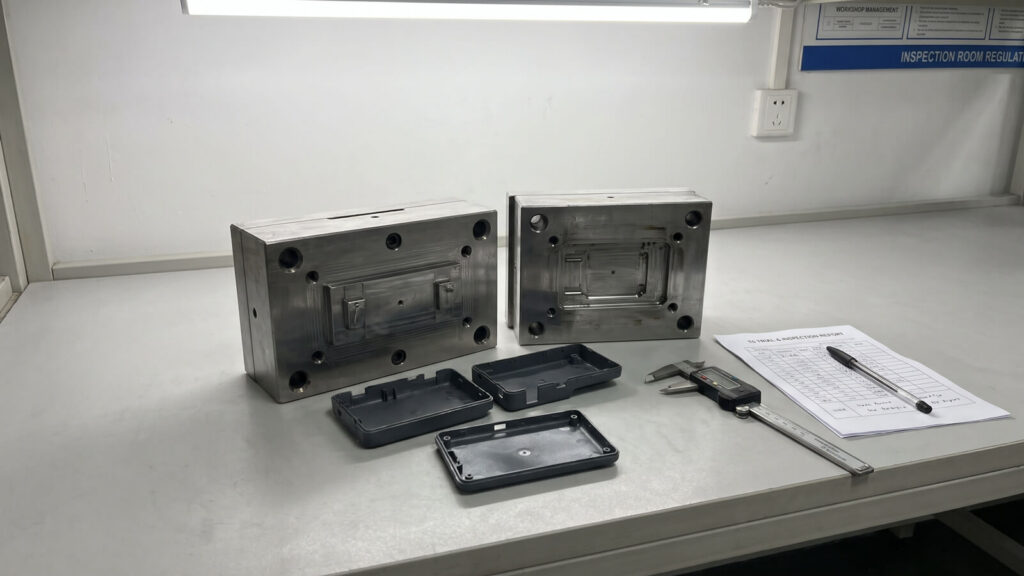
Auditing a mold making partner requires looking past polished sales decks and inspecting their metrology lab and quality closed-loop systems. At YG TECH, our quality assurance metrology center acts as an independent gatekeeper before any tool is approved for mass production or export:
- CMM & Optical Metrology Verification: Every precision electrode, core insert, and T0 plastic sample is inspected using Hexagon Coordinate Measuring Machines (CMM) and 2D optical projectors. According to ISO 20457 (formerly DIN 16742) precision plastic molding standards, holding tight functional tolerances on engineering polymers requires controlling both steel machining accuracy (±0.01 mm) and scientific molding process windows (Source: ISO 20457 Plastics Molded Parts Tolerances).
- Internationally Audited Certifications: Our facility operates under certified ISO 9001, ISO 14001, and ISO 13485 quality management systems, and has successfully passed rigorous factory audits for Amazon and Walmart supply chains.
- In-House RoHS & GRS 4.0 Material Verification: Every incoming batch of resin undergoes internal XRF testing for RoHS 1.0 and 2.0 compliance. For eco-conscious brands in North America and Europe, we hold GRS 4.0 (Global Recycled Standard) certification, providing full chain-of-custody documentation for sustainable recycled plastics.
- Closed-Loop Quality Accountability: Unlike brokers who evade responsibility or offer superficial replacements when defects arise, we enforce a strict root-cause traceability + collaborative engineering resolution workflow. If an anomaly occurs, we trace the exact molding cavity, resin drying log, and pressure curve to permanently resolve the root cause.
7. Frequently Asked Questions (FAQ) for Hardware Engineers & Buyers
Q1: How does YG TECH protect our Intellectual Property (IP) and who owns the mold?
IP protection starts before you share a single file: we sign a legally binding Non-Disclosure Agreement (NDA) upfront, and all CAD data is stored on encrypted, access-restricted internal servers. Crucially, once your final tooling payment is settled, 100% of the physical mold ownership—along with all 2D/3D mold assembly drawings—belongs exclusively to you.
Q2: Can we run low-volume production in China, or export the mold to the US/EU?
We support both paths seamlessly. Most SME brands prefer running production in our 50T–800T facility because our standard MOQ is just 1,000 pieces, backed by convenient EXW or DDP door-to-door delivery and flexible payment terms (including 100% prepayment for fast-track micro-orders, standard 50% deposit, or Net 30 credit terms for qualified partners). However, if you require export tooling for a US or European molding plant, we build molds to DME/HASCO/LKM export standards and ship them in fumigated sea/air crates with complete electrode data, steel certificates, and trial videos.
Q3: What happens if T0 samples deviate from our approved engineering print?
Our mandatory DFM and steel-safe machining protocols prevent most dimensional deviations upfront. However, if T0 samples fall outside agreed print tolerances due to toolroom machining error, YG TECH executes the steel modifications at our own expense and delivers validated T1 samples within 3 to 5 days.
Start Your Tooling Project with Data, Not Guesswork
Upload your 3D CAD files (STEP/IGES) under strict NDA. Within 24 hours, our senior tooling engineers will provide an itemized quotation alongside a practical DFM feasibility report—highlighting parting line layouts, steel recommendations, and cycle-time estimates.
Option 1: 10-Day MUD Rapid Tooling
Validating a new hardware design? Cut upfront mold costs by 30% and get real injection-molded T0 samples in 10 days.
Get a 10-Day MUD Quote →Option 2: Free Engineering DFM Audit
Planning a 1K+ unit production run, 2K overmold, or LSR tool? Speak directly with our engineering team to optimize your CAD for molding.
Submit CAD for Free DFM Analysis →